Table of Contents
- Why Adhesive Chemistry Determines Device Success
- Acrylic Medical Adhesives: Strength and Long Wear
- Silicone Medical Adhesives: Gentleness and Repositioning
- Side-by-Side Comparison
- How to Choose for Your Wearable
- Testing and Validation Requirements
- 2026 Hot Topics in Medical Adhesive Chemistry
- FAQ: Silicone vs Acrylic Medical Adhesives
Choosing between silicone and acrylic medical adhesives is one of the most consequential material decisions in wearable device design. The adhesive sits between the skin and the sensor, pump, or patch housing, and its chemistry controls bond strength, wear duration, skin tolerance, removal trauma, and even the device's commercial return rate. Acrylic systems dominate long-wear fixation where a firm bond matters; silicone systems dominate gentle, repeated-removal applications where skin fragility matters. This guide compares the two families on the engineering parameters that device makers actually test, explains which fits CGM patches, insulin pump sites, and diagnostic wearables, and shows how to validate the choice before production. For the broader material landscape, see our dedicated medical adhesive materials and films resource.
Why Adhesive Chemistry Determines Device Success
A pressure-sensitive medical adhesive (PSA) bonds at room temperature under light pressure, without heat or solvent curing. Its polymer backbone, tackifying resin, crosslink density, and coating thickness together define four outcomes: how aggressively it grabs the skin (tack), how much force resists peeling (peel adhesion per ASTM D3330 / PSTC-101), how long it holds under static load (shear per ASTM D3654 / PSTC-107), and how it behaves on removal. Get that chemistry wrong and even a perfectly engineered housing will lift, irritate, or fail to stay on. The non-chemical variables — skin preparation, backing breathability, cut geometry, and environmental moisture — are covered in our overview of factors affecting adhesive performance.
Acrylic Medical Adhesives: Strength and Long Wear
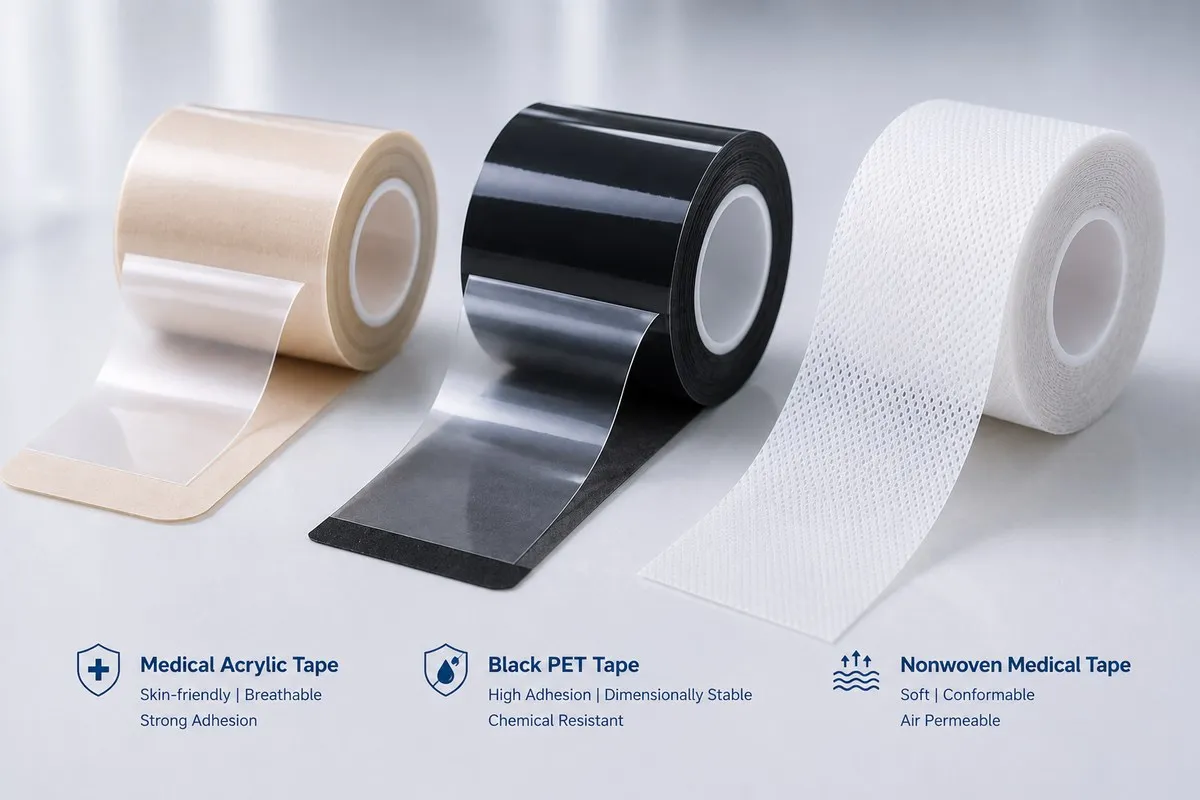
Acrylic (polyacrylate) adhesives are copolymers formulated from acrylic esters, tuned with crosslinkers and tackifiers. They are the default choice when fixation duration is the priority.
Strengths
- High peel and shear: acrylic systems build a firm, durable bond that resists sweat, showering, and body movement across multi-day wear windows.
- Aging stability: they resist oxidation and temperature drift well, giving a long shelf life and consistent lot-to-lot performance.
- Oil and moisture tolerance: formulated grades maintain tack on moderately oily skin and humid environments better than many silicones.
- Cost efficiency: acrylic-coated films and nonwovens are widely available at scale, supporting high-volume programs.
- Chemical versatility: compatible with nonwoven, film, foam, and foil liners, and easy to coat onto multilayer stacks.
Limitations
- Higher removal trauma: the firm bond can pull the stratum corneum during removal, causing redness, hair-pull, and discomfort, especially on repeated changes.
- Sensitization risk: a subset of users develop contact sensitization to acrylic monomers; low-sensitization grades reduce but do not eliminate this.
- Less repositionable: once pressed down, acrylic bonds are hard to lift and reapply without losing tack.
These traits make acrylic the standard for custom CGM adhesive patches and other 7–14 day fixation where detachment cost exceeds removal discomfort.
Silicone Medical Adhesives: Gentleness and Repositioning
Silicone PSAs are based on polydimethylsiloxane (PDMS) resins blended with silicone tackifiers. They bond through a different mechanism — gentle contact rather than aggressive grab — and are built for skin comfort.
Strengths
- Low skin trauma: silicone removes cleanly with minimal stratum-corneum pull, making it preferred for fragile, aged, neonatal, or frequently re-dressed skin.
- Hypoallergenic profile: silicone has a low sensitization rate and rarely triggers allergic contact dermatitis.
- Repositionable: it can be lifted, adjusted, and reapplied several times while retaining tack, easing accurate placement.
- Breathability and softness: silicone systems pair naturally with soft, conformable backings that move with the skin.
- Compatible with sensitive sites: useful around wounds, ostomy borders, and thin skin where acrylic would damage tissue on removal.
Limitations
- Lower ultimate hold: silicone generally delivers lower peel and shear than high-tack acrylic, so it struggles with very long, active-wear or heavy-housing loads.
- Sensitivity to oil and silicone residue: lotions containing silicone oils can block the bond.
- Higher material cost: silicone-coated constructions typically cost more per unit.
- Longer bond build-up: full strength develops more gradually than aggressive acrylic.
Silicone is commonly specified for insulin pump adhesive components changed every few days, wound-contact borders, and pediatric devices where gentle removal matters. For a broader view, read our guide to skin-friendly medical adhesives.
Side-by-Side Comparison
| Parameter | Acrylic PSA | Silicone PSA |
|---|---|---|
| Primary bond goal | Strong, long-duration fixation | Gentle, comfortable contact |
| Typical wear window | 7–14 days | 1–5 days, repeated changes |
| Peel adhesion | High | Low to moderate |
| Shear holding | High | Moderate |
| Removal trauma | Higher; can pull skin/hair | Minimal; clean release |
| Sensitization risk | Moderate; use low-sensitization grades | Very low |
| Repositionable | No | Yes, multiple times |
| Moisture / sweat resistance | Strong when formulated | Moderate |
| Cost at volume | Lower | Higher |
| Best fit | CGM patches, long-wear sensors | Sensitive skin, wound borders, frequent changes |
How to Choose for Your Wearable
Select the adhesive by prioritizing the device's dominant failure mode rather than chasing the "strongest" bond:
- Define the required wear window. A 14-day CGM sensor favors acrylic; a daily or every-few-day dressing favors silicone.
- Profile the user skin. Pediatric, elderly, eczema-prone, or fragile skin shifts the decision toward silicone regardless of duration.
- Assess housing load. Heavy transmitters and pumps need the shear headroom of acrylic; light sensors can run on silicone.
- Plan removal frequency. Repeated daily removal makes skin trauma the dominant risk, favoring silicone.
- Match the backing. Acrylic bonds well to nonwoven and film; pair silicone with soft, conformable carriers as explained in selecting medical adhesives for wearable devices.
- Consider hybrid stacks. Some products use a high-tack acrylic edge ring with a softer silicone center to anchor firmly while cushioning the housing.
These choices sit inside the larger mechanical design covered in our wearable medical device adhesive design guide, where backing, layering, and validation are addressed together.
Testing and Validation Requirements
Whichever chemistry is chosen, it must be validated rather than assumed. A medical converter should run peel adhesion (ASTM D3330 / PSTC-101), shear holding (ASTM D3654 / PSTC-107), tack, thickness, aging, and water-resistance testing, plus biocompatibility per ISO 10993 for skin contact. Documented lot traceability and an ISO 13485 cleanroom converting process support FDA 510(k) and EU MDR technical files. The transition from material sample to validated batch is described in our guide on moving medical adhesive components from prototype to production, and our converting capabilities show the die-cutting and lamination equipment behind the tests.

2026 Hot Topics in Medical Adhesive Chemistry
- Dual-durability hybrid adhesives: single coatings that combine acrylic-like edge hold with silicone-like center comfort are entering commercial wearables.
- Lower-sensitization acrylics: reformulated monomers aim to close the comfort gap with silicone without sacrificing 14-day hold.
- Sustainable silicone and bio-based acrylics: manufacturers are evaluating renewable feedstocks and recyclable liners while keeping biocompatibility intact.
- Custom formulation by skin phenotype: brands increasingly request adhesive grades tuned to oily, dry, or sensitive skin segments rather than one universal system.
- Smart-release coatings: adhesives that release cleanly on command (heat, moisture, or a trigger layer) reduce removal trauma for both chemistries.
- Integration with continuous monitoring: adhesion data from connected wearables feeds back into formulation tweaks for the next production lot.
Across wearable medical device applications, the trend is toward matching chemistry to use case rather than defaulting to the strongest available bond.
FAQ: Silicone vs Acrylic Medical Adhesives
Is acrylic or silicone adhesive better for a 14-day CGM patch?
Acrylic is usually the better fit for a 14-day wear window because its higher peel and shear hold up against sweat, showering, and movement. Silicone's gentler bond rarely maintains two-week fixation on its own.
Why does acrylic adhesive hurt when removed?
Acrylic forms a firm bond with the stratum corneum, so peeling pulls surface skin cells and hair. Low-sensitization grades and warm-water removal reduce discomfort, but silicone removes with far less trauma.
Can silicone adhesive hold an insulin pump securely?
Yes, for the typical 2–3 day infusion-set change cycle, formulated silicone provides adequate hold with gentler removal. For heavier pumps or very active users, an acrylic edge ring or hybrid stack may be added.
Are silicone medical adhesives truly hypoallergenic?
Silicone has a very low sensitization rate and is widely considered hypoallergenic, but no adhesive is universally non-reactive; clinical skin-compatibility testing under ISO 10993 should still be performed for the specific product.
Can I switch between acrylic and silicone on the same device?
The backing, liner, die geometry, and validation were tuned to the chosen chemistry, so switching requires re-testing peel, shear, aging, and biocompatibility rather than a simple substitution.
Which adhesive costs less at high volume?
Acrylic-coated films and nonwovens generally cost less per unit at volume, while silicone constructions carry a higher material premium justified by gentleness and repositionability.
Leetoya converts both acrylic and silicone medical adhesive components under ISO 13485 cleanroom conditions, supporting material selection, prototyping, and validated production. Send your stack drawing and wear requirements for an adhesive recommendation and sample.