
Wearable medical devices are moving from short-term clinical monitoring toward sensors that live on the skin for two weeks or longer, collecting glucose, temperature, cardiac, respiratory or activity data continuously. That shift changes what the adhesive and backing laminate must do: a patch that survives a few hours of observation faces very different demands than one worn through showers, sweat, exercise and daily clothing friction for 14 to 21 days. This article explains the material and adhesive engineering behind today's long-wear biosensors, how designers balance adhesion against breathability and gentle removal, and how material choices are validated before cleanroom production.
Table of Contents
- Why Wearable Medical Devices Keep Getting Smaller and Longer-Wearing
- The Engineering Demands of 14–21 Day Skin Attachment
- Adhesive Platforms Built for Long-Wear Biosensors
- Carrier Films, Nonwovens and Breathable Backing Structures
- Design Requirement to Material Solution
- Validation Path: From Material Samples to Cleanroom Production
- Frequently Asked Questions
Why Wearable Medical Devices Keep Getting Smaller and Longer-Wearing
The wearable segment is expanding because devices are becoming more comfortable to live with. Continuous glucose monitoring (CGM) illustrates the trend clearly: sensor wear windows have extended toward 21-day use, an increasing share of products rely on factory calibration rather than routine fingerstick checks, and accuracy targets push mean absolute relative difference below 9% in leading systems, according to market trend reporting from Intel Market Research. Smaller electronics, better battery management and predictive alert features make sensors something patients wear continuously rather than remove between readings.
That longer contact time raises the bar for every material touching the skin. A short-wear electrode can rely on a simple aggressive adhesive; a two-week sensor must hold through normal life while remaining breathable, removable without skin trauma, and compatible with sweat, showering and movement. Device makers therefore treat the fixation laminate as a core engineering subsystem rather than an accessory sticker. Our work across wearable medical devices reflects this shift: patches, overpatches and fixation components are designed alongside the sensor body, not after it.
The Engineering Demands of 14–21 Day Skin Attachment
A long-wear laminate has to satisfy several competing requirements at once. First, it must establish and retain secure adhesion across the full wear window—initial tack on application, sustained peel and shear through body movement, and resistance to edge lift around the sensor perimeter. Second, it must stay comfortable: the backing should conform to curved skin, flex with bending and sweating, and allow enough vapor transmission to keep trapped moisture from macerating the skin. Third, it must remove gently at end of wear, avoiding adhesive residue and skin injury even when the patch has been in place for weeks.
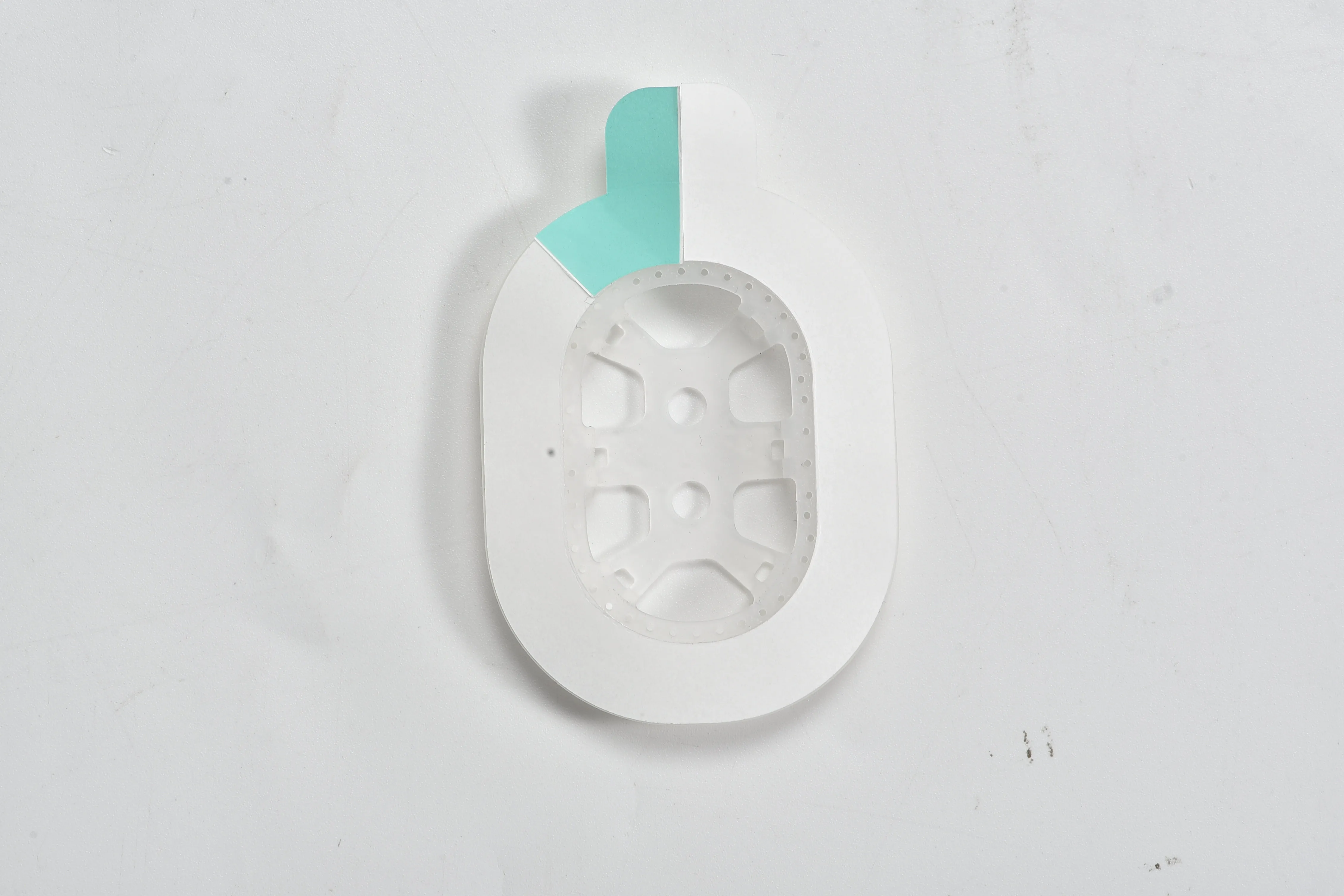
Other demands come from the environment and the device itself. Sweat, soap, sunscreen, clothing friction and sleep position all stress the bond. The patch must protect the sensor's insertion site or attachment interface, resist curling at exposed edges, and maintain consistent appearance through the wear window. For multi-part devices, the laminate may also anchor a heavier module, route strain away from the sensor, or provide a reinforcement layer that keeps the main patch from lifting. These requirements are translated into adhesive grade, coat weight, carrier thickness and liner selection during design.
Adhesive Platforms Built for Long-Wear Biosensors
Adhesive choice for a long-wear sensor balances grip against gentleness. Acrylic pressure-sensitive adhesives provide strong, predictable shear and peel and are widely used where dependable adhesion and cost efficiency matter; silicone adhesives are selected where gentle removal, repositioning and sensitive-skin comfort are priorities, and they retain peel force well across repeated handling. Hydrocolloid systems are used where moisture absorption and cushioning are the main functions. The right platform depends on the device weight, wear duration, skin population and removal expectations, and it is rarely chosen from a generic "best adhesive" list.
Coat weight and liner release are part of the adhesive specification too. Too little coat weight risks weak adhesion; too much can cause ooze, residue or overly aggressive peel. Release liners must protect the adhesive through storage and convert cleanly at assembly. When developing custom CGM adhesive patches, we evaluate the adhesive against the sensor's perimeter geometry, reinforcement overlay and intended wear window, and match the adhesive to the carrier rather than treating them as separate purchases. The same adhesive-system discipline applies to insulin pump adhesive components, where module weight and daily movement demand a stable shear platform.
Carrier Films, Nonwovens and Breathable Backing Structures
The adhesive does not carry the device alone; the backing and carrier determine conformability, breathability and mechanical strength. Thin film backings such as TPU films offer flexibility, moisture barrier properties and a smooth surface suitable for printing or overlay design, and they conform closely to body curves. Nonwoven materials provide a textile-like, breathable feel with good conformability and comfort during extended wear, often paired with a tuned adhesive so vapor can pass while moisture does not undermine the bond.
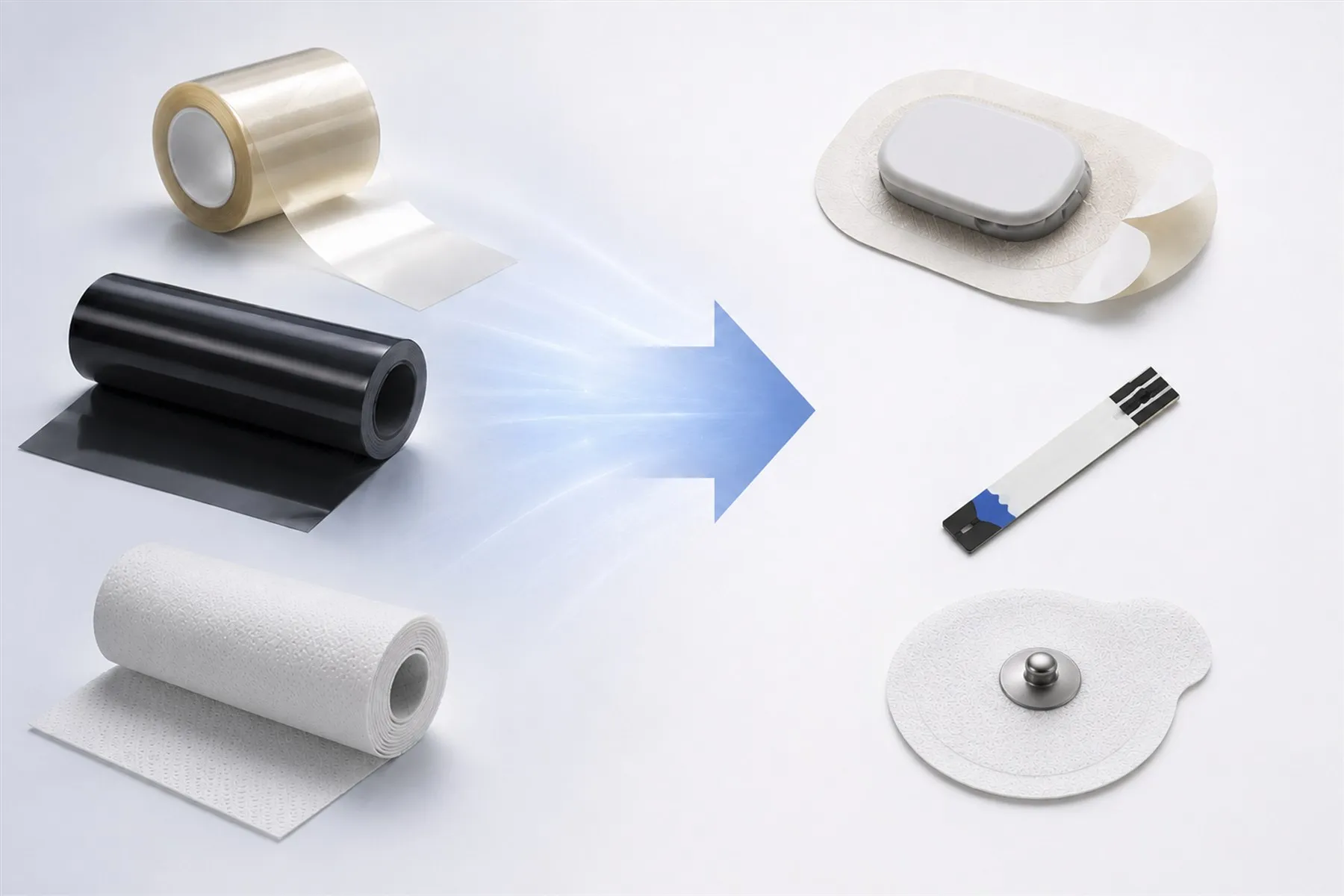
Layered designs combine these roles: a skin-contact adhesive layer, a load-bearing carrier or nonwoven, a reinforcement overlay where the sensor seats, and a release liner that protects everything until application. Foam layers may add cushioning where a module presses into the skin, and hydrophilic films may serve diagnostic capture or wicking functions in strip-style products. Selecting the stack means matching each layer's properties to the failure mode it controls—lift, shear, breathability, comfort or protection. The full medical adhesive materials platform lists these families side by side so designers can build the laminate intentionally.
Design Requirement to Material Solution
The table below maps typical long-wear design requirements to the material or adhesive response used in converting practice.
| Design requirement | Material / adhesive solution | Engineering notes |
|---|---|---|
| 14–21 day secure wear | Tuned acrylic or silicone PSA at controlled coat weight, paired with conformable carrier | Adhesion validated over the full wear window, not just initial peel |
| Sweat and shower resistance | Breathable nonwoven or film backing; moisture-managed adhesive grade | Vapor transmission tested against expected perspiration and washing conditions |
| Conformability to curved skin | Thin TPU film or flexible nonwoven carrier; die-cut perimeter matched to body area | Geometry and relief cuts reduce edge lift at bending points |
| Gentle removal and low trauma | Silicone adhesive or sensitive-skin acrylic grade; controlled peel force | Removal tested for residue, skin appearance and reappearance after wear |
| Sensor reinforcement and strain relief | Overlay patch or layered reinforcement around the sensor seat | Distributes stress so module movement does not peel the main patch |
| Sterilization and biocompatibility readiness | Medical-grade materials supplied with documentation; compatibility validated per device method | Confirm sterilization route and skin-contact class before locking the material |
| Clean, repeatable assembly | Appropriate release liner with defined release force; kiss-cut or island placement | Liner release and die geometry support reliable device assembly |
Validation Path: From Material Samples to Cleanroom Production
Material decisions for a long-wear sensor should be validated on prototypes that mirror the production converting route. Early samples let the team check tack, peel, conformability and print finish before committing to tooling; rapid sample turnaround—typically 3–7 days at Leetoya—means design iterations do not stall the program. Prototypes are built from the actual adhesive, carrier and liner candidates, not hand-applied substitutes, so what is tested reflects what will convert in volume.
Validation then moves through adhesion and peel checks, wear evaluation under realistic conditions, review of edge behavior and skin comfort, and confirmation that the laminate survives packaging, shipping and storage. Once the design is locked, production transfers to controlled converting under cleanroom conditions, with traceability linking material lots to finished patches. This sequence—material shortlist, prototype, validation, production release—keeps time to market short while preventing late-stage material failures that would force redesign. Our rapid prototyping service is built to move through these cycles in 3–7 day sample rounds so wearable teams do not wait on tooling before validating a new laminate.
If you are developing a long-wear sensor, patch or wearable module, our engineering team can support the material shortlist and prototype conversion. Request a quote or a prototyping consultation with your wear target, device geometry and skin-contact requirements, and we will propose a candidate laminate for evaluation.
Frequently Asked Questions
How long can a wearable medical sensor stay attached with the right adhesive?
With a tuned adhesive and conformable backing, skin-contact patches are engineered for 14–21 day wear windows in current long-wear sensor designs. Actual wear time depends on adhesive grade, carrier, body site, skin condition, sweat and friction, so it must be confirmed through prototype and wear testing rather than assumed from the adhesive alone.
What materials keep a long-wear patch breathable?
Breathability comes mainly from the backing structure: nonwoven carriers permit vapor transmission, and film backings such as TPU are selected for flexibility and moisture behavior. The adhesive layer also affects comfort, and the whole laminate should be evaluated for vapor management and skin maceration over the intended wear period.
Are silicone adhesives always better for long-wear devices?
Not always. Silicone excels at gentle removal and reapplication, but long-wear designs may use acrylic adhesives where strong shear and lower cost are priorities, with sensitive-skin grades chosen when needed. The best adhesive follows the device's weight, wear duration, skin population and removal requirements, validated in prototype form.
How do reinforcement overlays help a wearable sensor stay attached?
An overlay or reinforcement patch concentrates strength around the sensor seat and distributes module movement and strain away from the main patch edges. This reduces edge lift and peeling when the device shifts during activity, and it can extend effective wear life without changing the outer patch design.
When should material selection be finalized in a device program?
Material selection should be locked after prototype testing but before production tooling and packaging are fixed. Swapping adhesive, film or liner late in development reopens adhesion validation, regulatory documentation and assembly checks. Early prototyping is the cheapest stage to test and change material combinations.