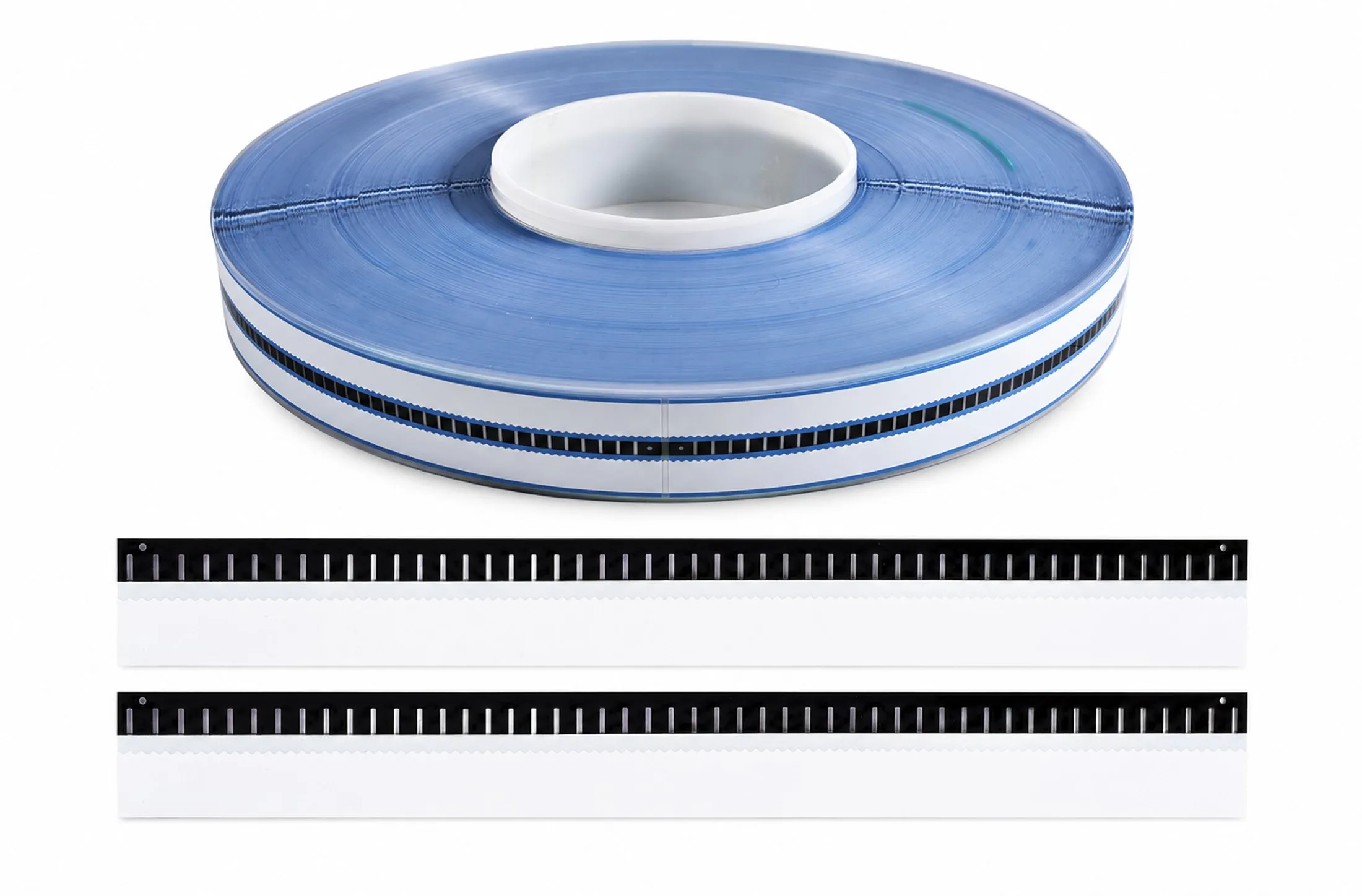
A blood glucose test strip is usually described by its electrodes and its enzyme. The layer that most often determines whether two strips behave identically, however, is the spacer tape. It sets the capillary channel height, bonds the top and bottom webs together, and defines how blood fills the measurement chamber. When strip-to-strip variability appears in a line that has already validated its chemistry, the spacer is the first place to look.
This article explains what the spacer actually does inside the strip, how it is produced, and which tolerances a device manufacturer should hold a supplier to.
Where the Spacer Sits in the Strip
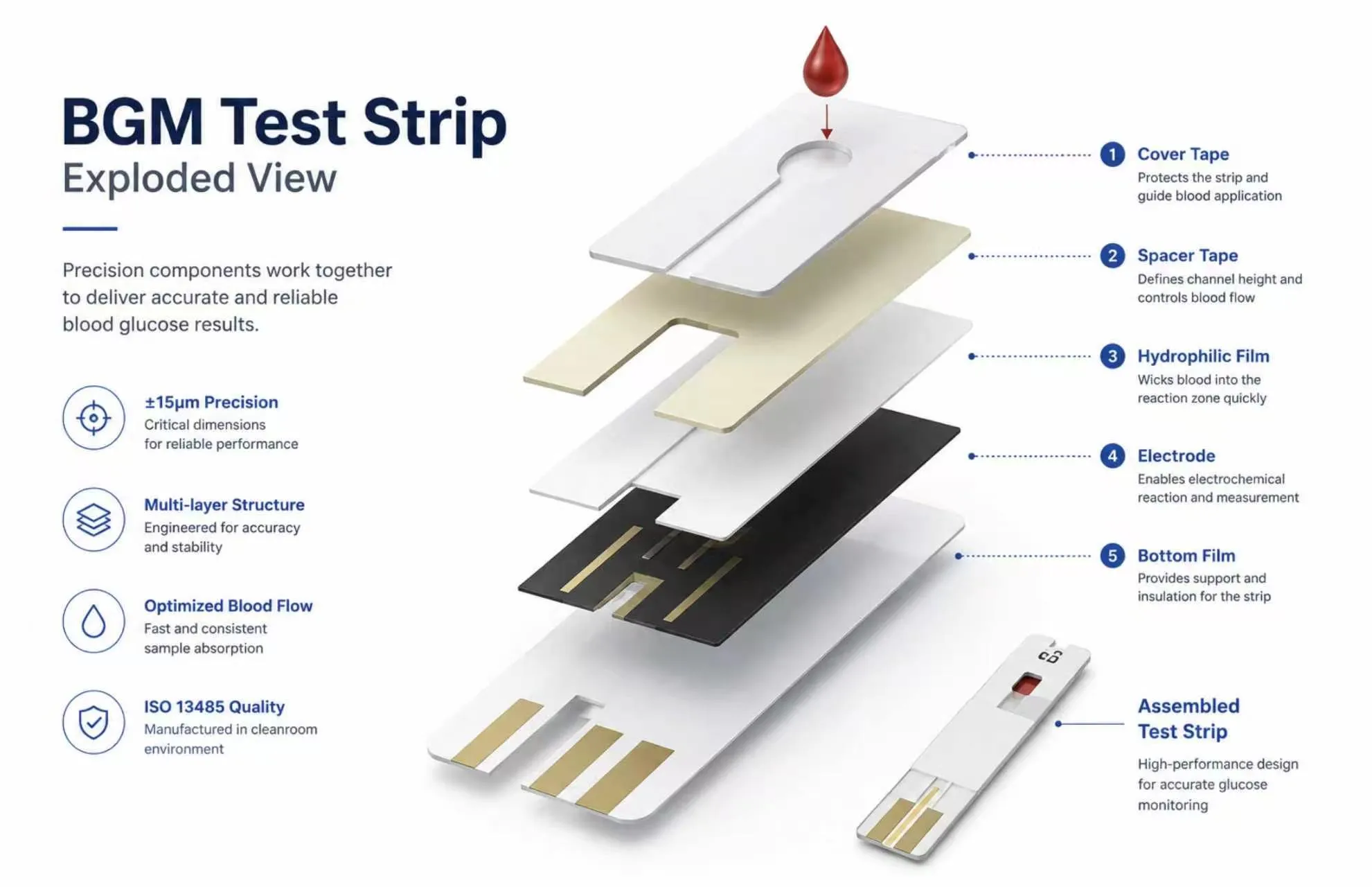
Most electrochemical glucose strips are built as a sandwich. The base web carries the electrodes and the reagent layer. Above it sits the spacer, a double-coated tape with a channel cut through it. The top web, often carrying the hydrophilic treatment that drives capillary action, closes the sandwich.
Blood enters the channel at the open end by capillary action, fills the measurement zone, and the reaction current is read at the electrodes. Channel height is therefore a geometric parameter in an electrochemical measurement, not merely a mechanical one.
Three Functions, One Layer
First, the spacer sets channel height. Height controls fill rate, required sample volume and the ratio of sample volume to electrode area. A channel that is too low fills slowly and is sensitive to hematocrit; one that is too high needs more blood and may allow the sample to sit outside the electrode zone.
Second, it bonds. The spacer adhesive must hold the top and bottom webs together through slitting, packaging, shipping and storage, without creeping into the channel. Adhesive intrusion is a silent failure: the strip still fills, but the effective channel narrows and the response curve shifts.
Third, it stabilises the liner and the web. During lamination the spacer brings its own release liner, which must release cleanly at the right station without distorting the thin carrier. A liner that peels unevenly creates tension variation and shows up later as dimensional drift.
Tape Construction and Thickness Range
A typical spacer tape is a PET carrier of 50 to 100 microns, double-coated with pressure-sensitive adhesive on both sides, protected by release liners. Total thickness for glucose strips commonly sits in the 80 to 200 micron range, depending on the channel design and the sample volume target.
Thickness tolerance is the specification that matters most. A plus or minus 10 micron band on a 100 micron tape is a ten percent variation in channel height, which is enough to change fill behaviour across a production lot. Suppliers who quote thickness as a nominal value with a commercial tolerance are not able to support a validated strip program.
Adhesive choice follows the webs. Acrylic adhesives are the common choice for their bond strength and clean converting; where the top web carries a hydrophilic coating, the adhesive must not migrate into that coating and alter its surface energy.
Coating Control and Slitting Precision
Spacer tape is usually supplied as a master roll that is slit to the width required by the strip layout. Slitting precision determines edge straightness, and edge straightness determines whether the channel is truly rectangular after lamination.
Ask for the slitting tolerance on width and the edge quality specification. A slitting line that produces a wavy edge will create a channel whose effective height varies along its length, which is invisible in a visual inspection but measurable in fill-time testing.
Coat weight uniformity matters as much as thickness. Uneven adhesive coat weight produces localised bonding differences and, in extreme cases, adhesive cold flow into the channel during storage. Coating lines should be monitored for coat weight across the web width, not only down the length.
Lamination and Registration
The spacer is laminated between two webs, and the channel is usually cut either before lamination or as part of the same registered operation. In both cases, registration between the channel and the electrode pattern is the critical dimension.
Registration error shifts the channel relative to the measurement electrode, which changes the electrochemically active area. The result is a strip that reads consistently but reads the wrong value, which is the most dangerous failure mode in diagnostic manufacturing because it passes functional test.
This is why channel-to-electrode registration should be specified as a micron tolerance with a defined measurement method, and why the converter should be able to show capability data rather than a conformance statement.

Defects That Reach the Patient
Four defects account for most spacer-related field issues. Adhesive bleed into the channel narrows the flow path and raises fill resistance. Channel skew from registration error changes electrode area. Delamination or trapped air creates a bubble that blocks filling. Thickness drift across a lot changes sample volume requirements.
Each has a corresponding in-process control: coat weight and channel width inspection, registration vision checks, peel and bond strength testing, and thickness measurement at multiple points across the web. A supplier that measures only final strip function is relying on the customer to find its process problems.
Evaluating a Spacer Tape Supplier
Evaluate on five dimensions. Thickness capability: what band can be held, measured how, with what sampling. Slitting quality: width tolerance and edge straightness. Adhesive compatibility: which chemistries are available and how migration is controlled against hydrophilic coatings. Cleanroom and contamination control: where the material is slit and laminated. Documentation: coat weight records, first article reports and change notification.
Price per roll is a poor proxy for cost. A tape that runs reliably at high yield is cheaper than a tape with a wider tolerance band that forces increased functional testing and field returns. For a broader view of how precision converting supports diagnostic components, see our BGM adhesive components capability and the spacer layer explainer.
Frequently Asked Questions
What thickness tolerance should a BGM spacer tape supplier hold?
For validated strip programs, a band of plus or minus 10 microns on the total tape thickness is a practical baseline, measured with a defined method and sampling plan. Wider bands translate directly into channel height variation.
Why does adhesive bleed into the channel matter?
Adhesive that flows into the channel narrows the flow path, slows filling and changes the effective electrode area. The strip may still pass a basic functional check while reading outside specification.
Should the channel be cut before or after lamination?
Both routes exist. Cutting before lamination requires excellent registration during lay-up; cutting after lamination requires clean separation without delamination. The right choice depends on volume and the converter equipment base.
How is channel-to-electrode registration verified?
By vision inspection of the laminated web, referenced to fiducial marks on the electrode pattern, with capability data over multiple lots rather than a single conformance certificate.
Does cleanroom production matter for spacer tape?
The spacer contacts the sample path, so particle contamination can obstruct a channel. Slitting and lamination in a controlled environment with documented monitoring reduces that risk.
What documentation should accompany each lot?
Thickness measurements across the web, coat weight records, slitting width data, first article inspection, and a change notification commitment covering adhesive, carrier and liner substitutions.
Conclusion
Spacer tape is a functional layer, not a commodity. It sets channel height, bonds the strip, and carries registration that determines electrode area. Programs that treat thickness, slitting quality and adhesive behaviour as specifications rather than assumptions get consistent strips. Programs that buy on price per roll discover the difference in functional yield.
Leetoya produces BGM spacer tape and diagnostic adhesive components with tight thickness control and high-volume slitting, alongside precision lamination and die cutting. For construction detail, see the BGM spacer tape product page.
Discuss your material requirements. Send the channel height target, thickness tolerance and annual strip volume, and we will confirm which tape construction meets it. Contact our engineering team.