Sommaire
- Aperçu des technologies de découpe à l'emporte-pièce
- Rotary Die Cutting Explained
- Flatbed Die Cutting Explained
- Comparaison côte à côte
- When to Use Which Technology
- Transitioning from Prototype to Production
- FAQ
Choisir entre découpe rotative et découpe à plat is a fundamental decision in medical component manufacturing. The right choice depends on your production volume, material thickness, tolerance requirements, and product lifecycle stage. This guide helps you understand both technologies and select the right process for your projet de découpe à l'emporte-pièce médicale.

Die Cutting Technologies Overview
Medical device components require precise, repeatable cutting of adhesive tapes, films, foams, and nonwovens. The two dominant technologies in precision converting are rotary die cutting and flatbed die cutting. Each has distinct advantages, limitations, and ideal use cases. Many manufacturers offer both, allowing them to support customers from prototype through full production.
The choice between rotary and flatbed affects not only per-unit cost but also tooling investment, lead times, achievable tolerances, and minimum order quantities. Understanding these trade-offs early in the product development cycle prevents costly re-tooling decisions later.
Rotary Die Cutting
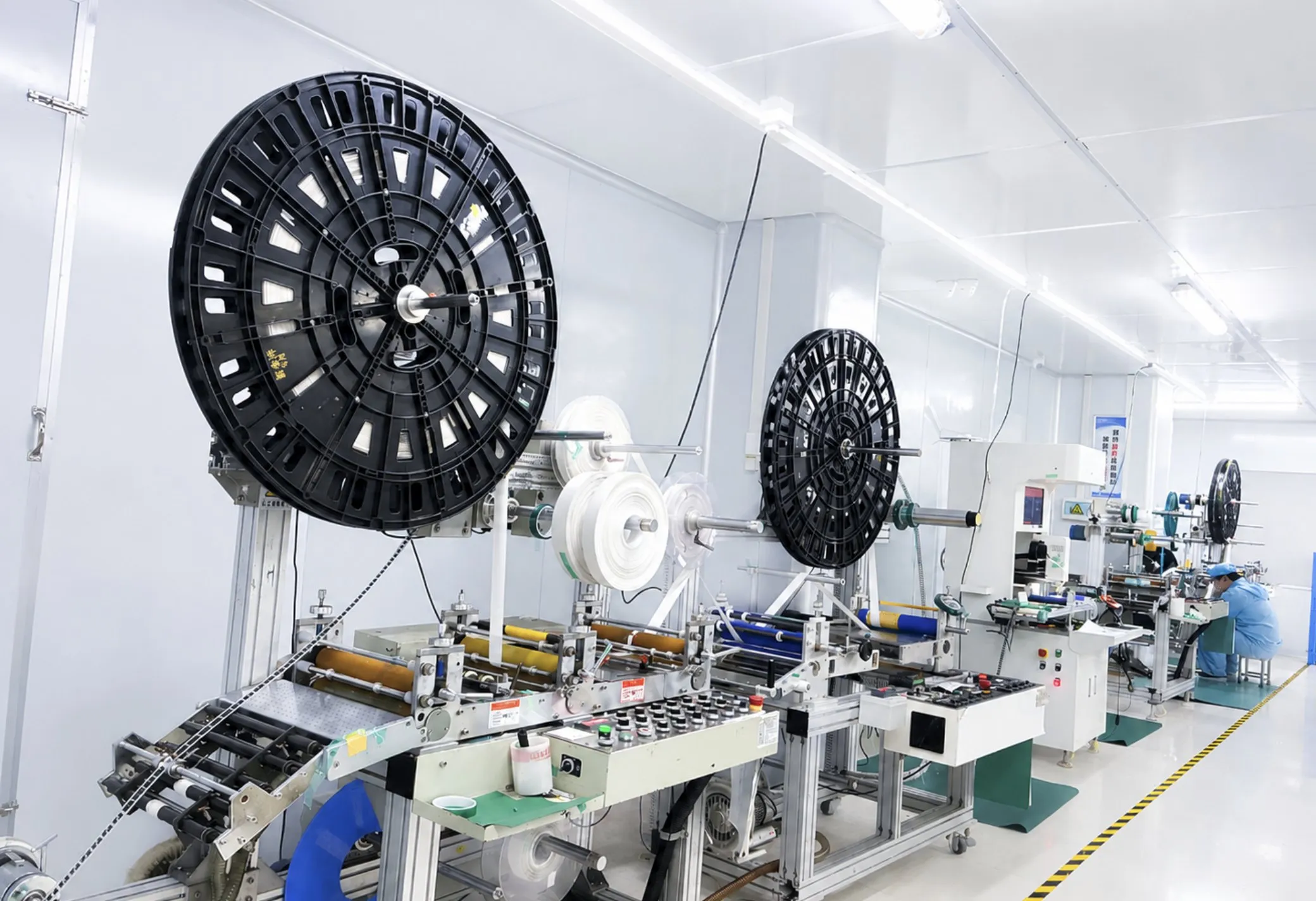
Rotary die cutting uses a cylindrical engraved die that rotates against a hardened anvil cylinder. Material feeds through continuously between the two cylinders. The rotating die makes clean, precise cuts at high speed.
Advantages of rotary die cutting:
- High production speed: 30-100+ meters per minute depending on material
- Tight tolerances: typically +/- 10-20 micrometers on critical dimensions
- Excellent for high-volume production: millions of pieces per month
- Inline lamination capability: multiple layers laminated and cut in one pass
- Kiss cutting capabilities for easy release liner removal
- Consistent quality across long production runs
Limitations of rotary:
- Custom tooling required (2-4 weeks lead time, $1,500-5,000 per tool)
- Best for thin materials (0.05-3mm thickness range)
- Minimum order quantities typically 50,000+ pieces
- Longer setup time for short runs
Rotary is the standard technology for high-volume medical components like CGM adhesive patches and BGM test strip components.
Flatbed Die Cutting
Flatbed die cutting uses a flat, reciprocating press that stamps material like a giant mechanical stamp. The die plate moves vertically onto the material, which lies on a flat cutting surface.
Advantages of flatbed die cutting:
- Lower tooling cost: $300-1,500 per die, 1-2 week lead time
- Handles thicker materials: up to 10-15mm foam or rubber
- Excellent for prototypes and short production runs
- Lower minimum order quantities: 500-5,000 pieces
- Easier design modifications during development
Limitations of flatbed:
- Slower speed: 10-30 strokes per minute depending on size
- Looser tolerances: +/- 25-50 micrometers typical
- Not cost-effective for very high volumes
- Edge quality may be slightly less clean than rotary
Flatbed is ideal for rapid prototyping, product development, and low-volume medical applications.
Side-by-Side Comparison
| Parameter | Rotary Die Cutting | Flatbed Die Cutting |
|---|---|---|
| Tolerance | +/- 10-20 um | +/- 25-50 um |
| Speed | 30-100 m/min | 10-30 strokes/min |
| Tooling Cost | $1,500-5,000 | $300-1,500 |
| Tooling Lead Time | 2-4 weeks | 1-2 weeks |
| Material Thickness | 0.05-3 mm | 0.1-15 mm |
| Best Volume | 100,000+ pieces/month | 1,000-50,000 pieces/month |
| Inline Lamination | Yes | Limited |
When to Use Which Technology
Choose rotary die cutting when:
- Your production volume exceeds 100,000 pieces per month
- You need tight tolerances (+/- 20 um or better)
- Your product has multiple layers requiring inline lamination
- The material is thin (films, tapes, thin foams under 3mm)
- You have a stable design and long product lifecycle
Choose flatbed die cutting when:
- Your volume is below 50,000 pieces per month
- Your product is still under development and designs may change
- You need thick materials (foam gaskets, cushioning over 3mm)
- You need fast turnaround for prototypes or validation batches
- Your shape complexity requires easy die modifications
Our manufacturing capabilities include both rotary and flatbed, allowing seamless transition as your product matures.
Transitioning from Prototype to Production
Many companies start with flatbed for prototyping and early production, then transition to rotary when volume justifies it. This phased approach minimizes initial investment and de-risks product development.
The good news: the die geometry translates directly between processes. A part designed for flatbed can almost always be produced on rotary with appropriate tooling modifications. Your converter should be able to estimate when the per-unit cost savings of rotary offset the tooling investment — typically at around 50,000-100,000 cumulative pieces.

FAQ
Is rotary die cutting always better quality?
No. Rotary excels at high-volume thin materials with tight tolerances, but flatbed is better for thick materials and lower volumes. Quality depends on the application, not just the technology.
Can I switch from flatbed to rotary later?
Yes. The part geometry translates between processes. Your converter will create a new rotary cylinder die based on your existing design. The transition typically takes 2-4 weeks.
How do I decide which process to use?
Provide your drawing, material specification, annual volume projection, and required tolerances to an experienced converter. They will recommend the most cost-effective process. Contact our engineering team for a detailed analysis.
What about laser cutting?
Laser cutting is a third option used for very low volumes and complex shapes. It has no tooling cost but is slower, may leave heat-affected edges, and has material limitations. It is best for early-stage prototyping.
Leetoya offers both rotary and flatbed die cutting in ISO 13485 certified cleanrooms, supporting products from prototype through mass production. Discuss your project requirements.