Supplier qualification is often treated as a purchasing formality: collect a certificate, request a sample, approve the vendor. For medical adhesive components, that shortcut reliably produces problems eighteen months later, when a material substitution, a tooling change or a capacity shift appears without warning and the device team has no basis to evaluate it.
This article sets out a five-stage qualification process that scales with device risk, and the specific evidence to request at each stage.
Three Things Being Qualified
First, the supplier: its quality system, its scope of registration, its capacity and its financial stability. Second, the material: the specific construction with its coat weight, liner and release properties, qualified to your specification. Third, the part: the converted component produced on a defined tool, on a defined line, with documented inspection.
Most qualification failures come from approving one of the three and assuming the others. A supplier with a strong quality system can still deliver a part that fails dimensional capability on a new tool. A material approved on a lab sample can still fail at production line speed.
Keep the three separate in the qualification file, and approve each explicitly.
Stage 1: Desk Assessment
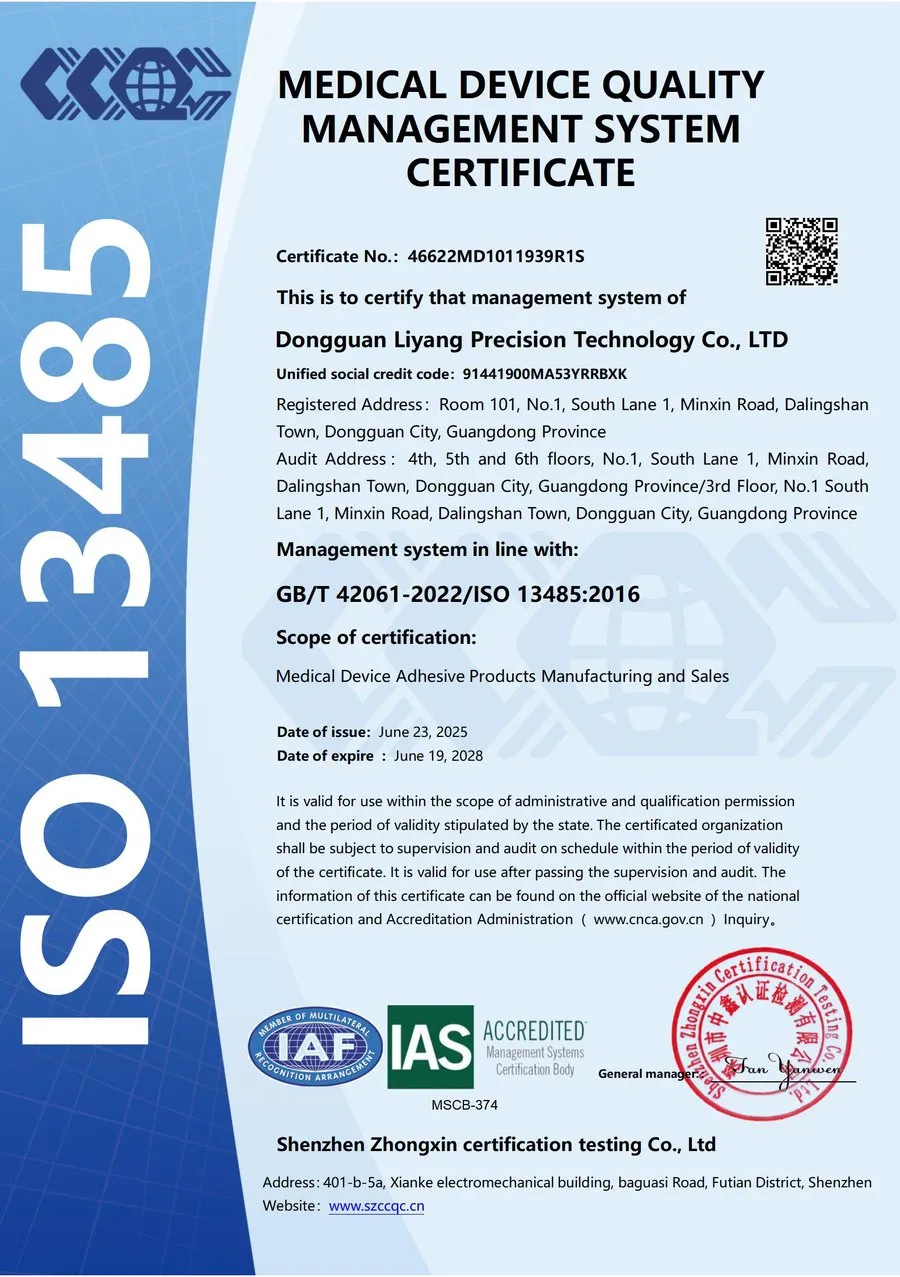
The desk stage filters out suppliers who cannot support a medical program before anyone travels. Request the quality certificate with its scope and expiry date, the latest audit report if the supplier was audited by a notified body, an organisation chart covering quality and engineering, a list of comparable programs, and a capacity statement.
Check the scope carefully. A certificate covering 'converting of adhesive tapes' is a different scope from 'manufacture of medical devices'. Neither is automatically disqualifying, but the scope tells you what the certified system actually controls.
Ask two questions that reveal more than the certificate: who signs a material change, and how customers are notified. A supplier that answers with a named role and a documented notification window is describing a system. A supplier that answers 'we inform customers' is describing an intention.
Stage 2: Process Audit
The audit should follow the material, not the meeting room. Start at receiving, follow a roll through slitting, lamination, cutting, inspection and packaging, and finish at the shipping dock. What you are testing is whether the documented process matches the physical one.
Four areas deserve time. Cleanroom discipline, observed during production rather than described in a slide. Metrology: which instruments, what calibration status, what measurement methods are defined for your critical dimensions. Change control: how a new liner, adhesive lot or tool revision is handled and who approves it. And traceability: whether a finished component can be linked back to a master roll lot.
Ask to see a nonconformance from the last twelve months and its disposition. Suppliers learn a great deal about themselves answering that question, and so do you.
Stage 3: Capability and Samples
Samples without data are a courtesy, not evidence. Request first article inspection on the critical dimensions with the measurement method stated, plus a capability study across multiple lots rather than a single run. For adhesive components the critical dimensions usually include overall profile, opening diameter, channel width, thickness and registration to a printed or electrode feature.
Review the distribution, not the mean. A process centred on nominal with a wide spread will pass a sample inspection and fail in production. A process slightly off nominal but tightly controlled is easier to correct.
At this stage also confirm material certificates: coat weight, liner release force and lot number for each roll used in the sample build.
Stage 4: Validation Builds
The validation build is where a supplier's process meets your assembly line. Run the component at production speed on your equipment, measure yield, and record the failure modes rather than only the pass rate. Liner release behaviour, static, web handling and part orientation often fail here after passing every bench test.
Define acceptance before the build. Agreed criteria prevent a discussion about whether a seventy percent yield is a success. Include a plan for what changes if it is not: tool adjustment, liner change, or a different adhesive zone layout.
Where the component is patient-contact, add biocompatibility and bioburden documentation at this stage, sourced from the material supplier and the converter respectively.
Stage 5: Continuity and Commercial Fit
Continuity questions are commercial but they determine technical risk. Ask about manufacturing sites: is there a second line, and would it be qualified before use? Ask about tooling ownership and whether the tool can be transferred. Ask about capacity headroom at your forecast volume and at twice that volume. Ask for a business continuity statement covering material supply and equipment failure.
Then test the answers. A supplier claiming dual-site capability should be able to explain how the second site would be qualified and how long it takes. If the answer is vague, treat it as single-site.
A Working Scorecard
Score each supplier on six dimensions with a 1 to 5 scale and a weight that reflects your device risk: quality system and audit findings, dimensional capability, cleanroom and contamination control, change control and notification, capacity and continuity, and engineering responsiveness.
Engineering responsiveness deserves a place. During a program, questions about liner behaviour or tolerance allocation arise constantly, and a supplier that answers them in days rather than weeks reduces your development risk more than a marginally better certificate does.
| Dimension | Evidence | Weight |
|---|---|---|
| Quality system | Certificate scope, audit report, CAPA examples | High |
| Dimensional capability | FAI, multi-lot capability data | High |
| Cleanroom control | Classification date, monitoring trend, observed practice | High |
| Change control | Notification window, approval role, recent changes | Medium |
| Capacity and continuity | Headroom, second line, tooling ownership | Medium |
| Engineering response | Turnaround on technical questions | Medium |
Red Flags
Five signals justify stopping early. Capability data that cannot be produced for the specific part. A certificate scope narrower than the work being quoted. Reluctance to name the person who approves material changes. Cleanroom claims with no classification report. And a tool that the supplier owns and will not release, which converts a supplier change into a redesign.
None of these is automatically fatal, but each converts a qualification into a negotiation, and that negotiation is easier before the purchase order than after.
For the manufacturing context behind these questions, see ISO 13485 for adhesive converting and ISO Class 7 cleanroom manufacturing.
Frequently Asked Questions
What is the difference between supplier, material and part qualification?
Supplier qualification covers the quality system, capacity and stability. Material qualification covers the specific construction and its properties. Part qualification covers the converted component on a defined tool and line. All three should be approved explicitly.
How much capability data is enough?
Multiple lots, not a single run, with the measurement method stated and the distribution reviewed rather than only the mean. Three lots is a practical minimum for a first assessment.
Should a supplier own the die cutting tool?
Preferably not exclusively. The device manufacturer should own or hold release rights to the tool with revision control, otherwise changing suppliers requires new tooling and re-qualification.
What does a material change notification clause need?
A defined notification window, a named approval role, and a requirement to supply equivalence data before the change ships. Vague commitments are not usable in a device technical file.
How is a validation build different from sample approval?
A validation build runs the component on the customer's equipment at production speed and measures yield and failure modes. Sample approval only demonstrates that the supplier can make conforming parts on its own line.
Do we need to audit a supplier that holds an ISO 13485 certificate?
Yes, typically. The certificate confirms a system exists; the audit confirms the system matches the process you are buying and is followed in practice.
Conclusion
Qualification is the process of replacing assurances with evidence: capability distributions instead of certificates, observed practice instead of described practice, validation builds instead of samples, and named responsibilities instead of intentions. A supplier that can support that process is a partner. One that cannot is a purchase order waiting to become a corrective action.
Leetoya provides qualification documentation including capability data, material certificates, cleanroom classification records and audit support for medical adhesive component programs. See about Leetoya and capabilities.
Request a supplier qualification pack. Tell us the component and device class, and we will send the documentation set your quality team needs. Contact our engineering team.