Cleanroom claims are easy to make and difficult to verify. A supplier can state ISO Class 7 on a website, print it on a certificate and still convert skin-contact adhesive in a room that only met the class on the day it was commissioned. For device manufacturers buying adhesive components, understanding what the class actually means and how it is maintained is the difference between a real control and a marketing line.
This article explains the ISO Class 7 specification, why adhesive converting needs a controlled environment, and the evidence a serious supplier should be able to produce.
What ISO Class 7 Actually Specifies
ISO 14644-1 defines cleanroom classes by the maximum permitted concentration of airborne particles. For ISO Class 7, the limits are 352,000 particles per cubic metre at 0.5 micrometres and larger, and 2,930 particles per cubic metre at 5 micrometres and larger. In the older Federal Standard 209 terminology this corresponds roughly to Class 10,000.
The class is defined at rest and in operation, and the two are different. A room that meets ISO 7 at rest but not during production does not protect the product, because particles matter most while the line is running. Any certificate worth reading states which condition it refers to.
Classification is also periodic. A room is classified by measurement, then monitored continuously or at intervals, and reclassified after changes to air handling, layout or process. A supplier that cannot state the date of its last classification test is describing history, not current control.
Why Adhesive Converting Needs Control
Adhesive converting is a particle-generating process. Die cutting shears material and produces fine debris at the cut edge. Slitting generates edge dust. Liner peeling can release particles and static-attracted contamination. Webbing and web guiding produce abrasion debris at contact points.
For a skin-contact CGM patch or a diagnostic strip, particles at the adhesive surface or inside the capillary channel are a direct quality risk. A particle under a patch edge is a lift initiation point. A particle in a strip channel obstructs fill. Neither is visible in a routine visual inspection.
The controlled environment, combined with gowning and cleaning, reduces the number of particles that can reach the product. It does not eliminate them, which is why environmental control and in-process inspection are complementary rather than alternatives.
Room Architecture and Air Handling
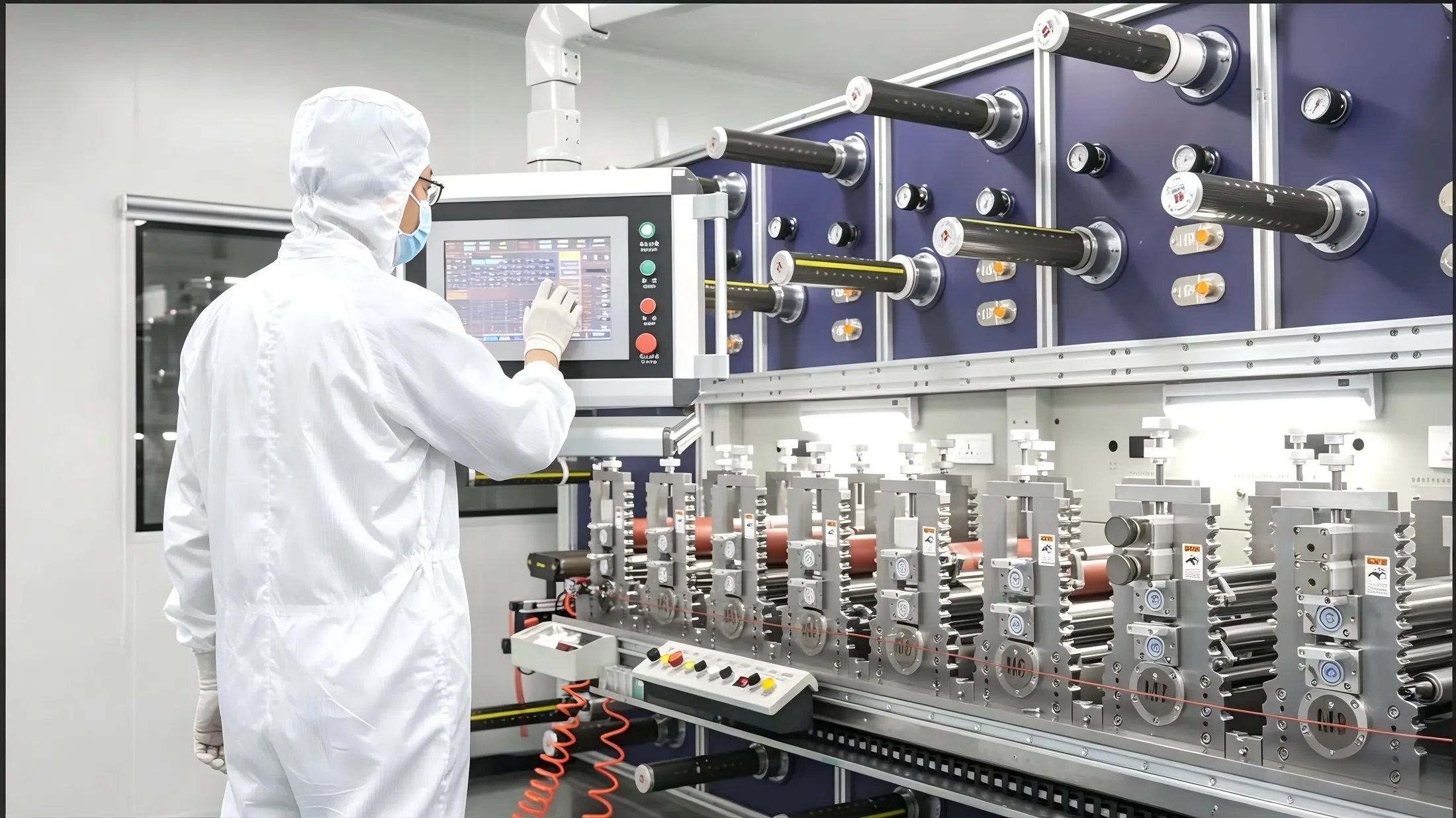
A cleanroom is an air system before it is a room. Filtered air is supplied through HEPA filters, usually at the ceiling, and returns at low level or through a raised floor. Air moves in a defined pattern, either unidirectional for the highest classes or mixed for lower ones. Pressure cascades from cleaner zones to less clean ones so that air flows outward, not inward.
Air change rate, filter coverage, and the pressure differential to adjacent spaces are the parameters that keep the class stable. Gaps at doors, penetrations for web pass-throughs, and poorly sealed equipment are the usual failure points.
Material transfer is the other architectural problem. Rolls enter through pass-through hatches or air locks, and the packaging must be removed in a controlled way so that outer contamination does not travel with the roll into the production zone.
Gowning and Personnel Flow
People are the largest particle source in most cleanrooms. Gowning procedure, gown type and the discipline of the change sequence determine how much of that reaches the product. For an ISO 7 room, coveralls, hoods, masks, gloves and boots are typical, with a defined sequence and a defined gowning area that is itself cleaner than the entry.
Personnel flow should be separated from material flow. A room where operators walk past unbagged waste or share a corridor with incoming cartons is not controlled in any meaningful sense.
Training and behavioural rules matter as much as the garment. Rapid movement, uncovered skin, jewellery, and paper in the production area all increase particle counts. An audit that only checks the gowning cabinet and not the operator behaviour is checking scenery.
Environmental Monitoring and Records
Monitoring is what turns a classified room into a controlled process. The minimum expectation is periodic particle counts at defined locations, differential pressure logging, temperature and humidity records, and a defined reaction plan when a limit is exceeded.
For skin-contact components, microbiological monitoring is also relevant: surface contact plates and air sampling at a defined frequency, with results trended rather than filed. A supplier that can show a trend chart over twelve months is demonstrating control. A supplier that can show a single passing report is demonstrating a test.
Records retention matters for device manufacturers because the supplier evidence becomes part of their own technical file. Ask how long records are kept and whether they are available during an audit.
Bioburden, Sterility and the Component Boundary
A CGM patch or a glucose strip component is not necessarily a sterile device. Many are manufactured to controlled bioburden limits and are not sterilised, because sterilisation would damage adhesives or reagents. Others are sterilised by the device manufacturer after assembly.
The important boundary is responsibility. A component supplier controls the manufacturing environment and can state a bioburden result; it cannot claim a clinical outcome. Claims about sterility, clinical performance or infection prevention belong to the finished device and its regulatory file.
Device teams should therefore ask for environmental and bioburden data, and treat clinical claims as their own responsibility. That distinction is also what keeps supplier marketing language honest.
What to Verify in an Audit
Six checks cover most of the substance. Ask for the last classification report with the date, the test house and the condition, at rest or in operation. Walk the air path and look for open doors, unsealed penetrations and blocked returns. Review the particle and pressure trend, not just the report. Observe gowning in practice during a shift change. Follow a roll from receiving to the press. And ask for the reaction plan that runs when a monitoring limit is exceeded.
Documentation of cleaning schedules, equipment qualification and personnel training completes the picture. None of these are expensive questions to ask, and all of them are difficult to answer convincingly without a real system.
For the operational side of cleanroom converting, see our cleanroom converting capability and the cleanroom converting basics note. For the quality system context, the ISO 13485 converting guide covers documentation requirements.
Frequently Asked Questions
What are the particle limits for ISO Class 7?
352,000 particles per cubic metre at 0.5 micrometres and larger, and 2,930 per cubic metre at 5 micrometres and larger, per ISO 14644-1. The class is defined both at rest and in operation, and the two conditions differ.
Is ISO Class 7 the same as Class 10,000?
It is approximately equivalent under the older Federal Standard 209 classification. The ISO numbers scale by powers of ten per class step, which is why ISO 7 sits near the old Class 10,000 level.
Does a cleanroom make the component sterile?
No. A cleanroom controls particle and microbiological contamination during manufacturing. Sterility is a separate claim that depends on sterilisation and belongs to the finished device, not the component supplier.
How often should a cleanroom be reclassified?
Classification is periodic and repeated after changes to air handling, layout or process. Monitoring in between is continuous or at defined intervals, and the trend matters more than a single passing test.
What is the most common cleanroom audit finding?
Open doors, unsealed penetrations and material transfer that bypasses the pass-through. Air path discipline fails before the filters do.
Do adhesive components really need a cleanroom?
Skin-contact and diagnostic components benefit from controlled manufacturing because cutting generates particles at the functional surface. The class should match the device risk, and ISO 7 is a common benchmark for such components.
Conclusion
ISO Class 7 is a measurable condition, not a badge. It is maintained by air handling, gowning discipline, cleaning and monitoring, and it is proven by trends rather than by certificates. Buyers who ask for the classification report, the monitoring trend and the reaction plan get a very different conversation from suppliers who only have a logo.
Leetoya converts medical adhesive components in ISO Class 7 cleanroom production under an ISO 13485 quality system, with documented environmental monitoring and full material traceability. See manufacturing capabilities for line details.
Get engineering support. Request our cleanroom classification report and monitoring summary alongside a drawing review for your component. Contact our engineering team.