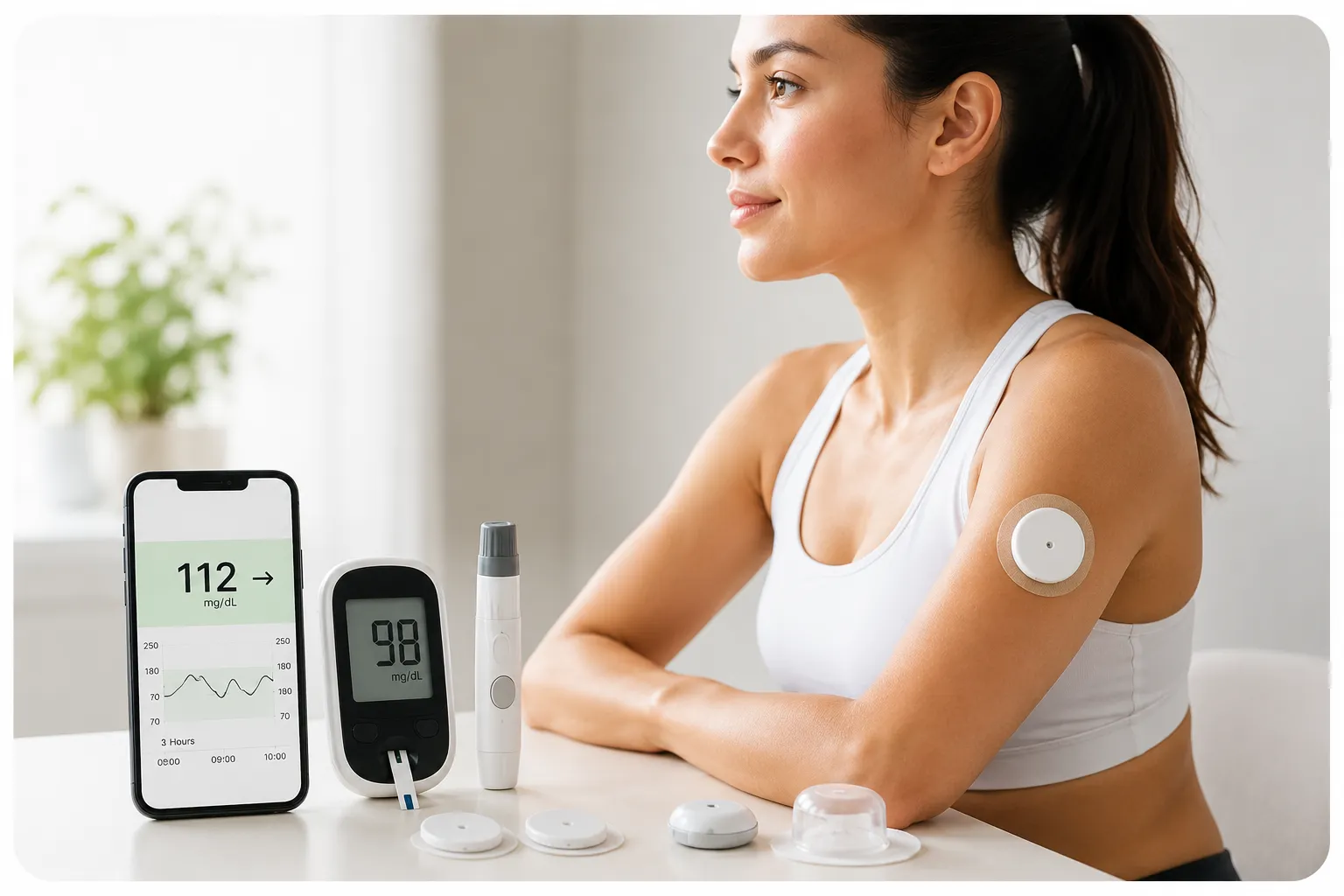
Device teams often ask for a patch benchmarked against a market-leading CGM, assuming there is a single best adhesive answer. There is not. The two dominant architectures, the Abbott FreeStyle Libre family and the Dexcom sensor family, place genuinely different mechanical demands on the skin interface, and a patch that performs well on one geometry can underperform on the other.
This comparison looks at design archetypes rather than marketing specifications. Brand names appear only as technical context; there is no affiliation, supply relationship or compatibility claim implied.
Two Design Archetypes
The Libre family in most markets is a circular, all-in-one sensor of roughly 35 mm diameter that is applied as a single unit and worn for up to fourteen days. There is no separate transmitter to attach. The skin interface is therefore a large, roughly circular adhesive disc whose load is almost entirely its own housing plus clothing shear.
The Dexcom G6 architecture separates the sensor from a reusable transmitter, which is clipped on after insertion. The G7 generation consolidates into a smaller all-in-one wearable. Across both generations the adhesive carries a compact housing plus, in the G6 case, a transmitter mass that sits above the skin and acts as a lever arm.
The distinction that matters for adhesive engineering is this: one archetype is a large area with modest local load, the other is a smaller area with a heavier, higher-centre-of-mass body.
Footprint and Load Path
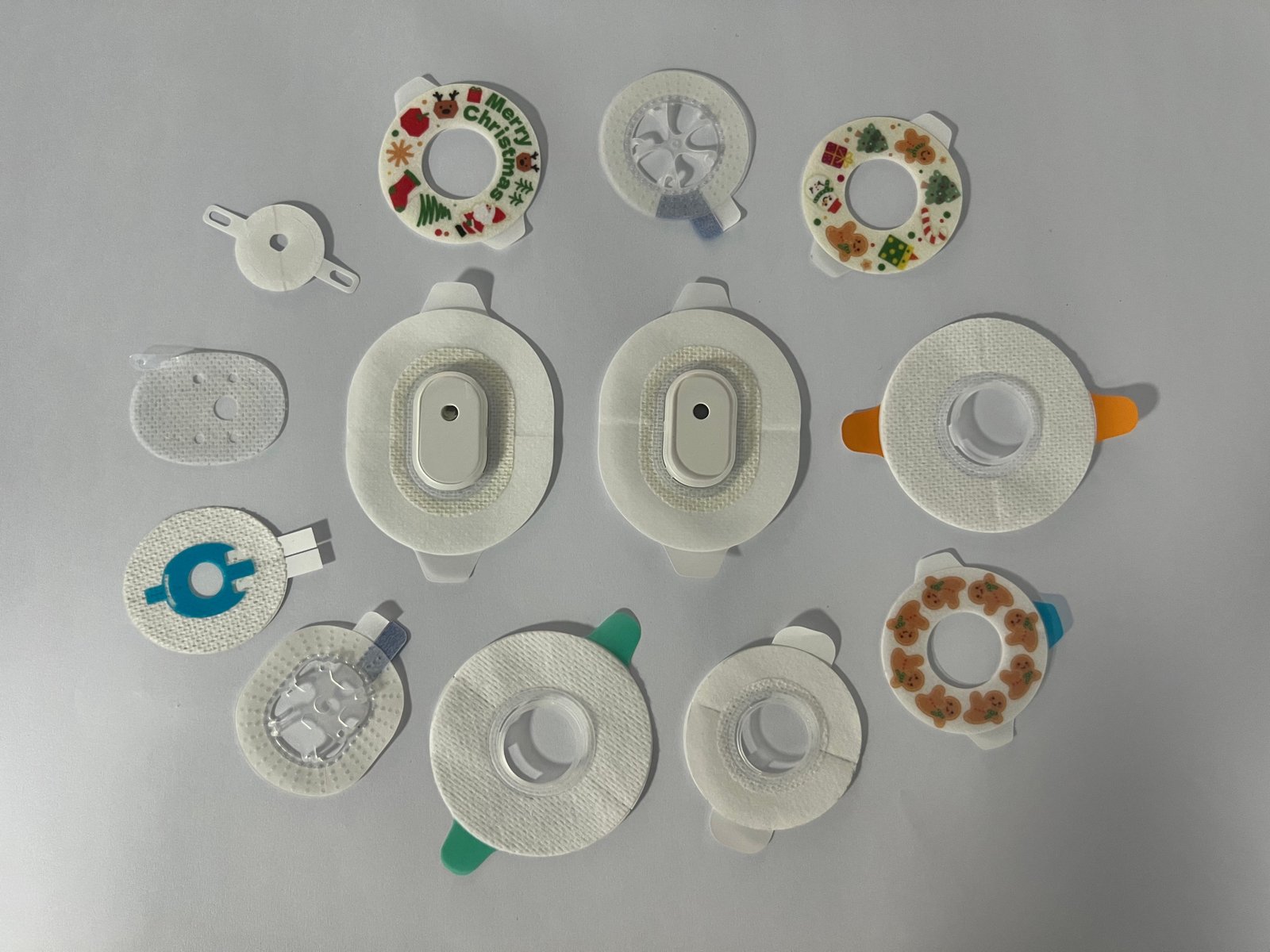
A circular 35 mm patch has roughly 960 square millimetres of adhesive area. A compact sensor patch of 25 by 30 mm has about 750 square millimetres, and the housing occupies a larger share of that area. The usable adhesive annulus around the housing, not the total area, is what resists peel.
This is why a smaller patch is not automatically a harder design: what matters is the ratio of load-bearing adhesive perimeter to housing mass. A large circular patch with a small central opening has a long peel path. A compact patch with a large opening has a short one and depends more on adhesive shear strength.
Housing Mass and Shear
Shear load scales with mass and with the height of the centre of gravity above the skin. A transmitter clipped over a sensor creates an overturning moment that pulls one edge into tension and pushes the opposite edge into compression. That asymmetry is why some patches lift on one side only, and why increasing the patch perimeter on that side is more effective than increasing adhesive coat weight uniformly.
For an all-in-one circular sensor, the housing is flatter and the moment arm is short, so the dominant load is in-plane shear from clothing and movement rather than overturning. In-plane shear is exactly what acrylic pressure-sensitive adhesives handle well, which partly explains why acrylic remains the default for this archetype.
Filament Insertion and Skin Deformation
Both archetypes insert a filament into subcutaneous tissue, and the filament constrains the skin directly above it. When the patch and the filament move independently, the insertion site is loaded in a way the skin does not like, which shows up as discomfort and, in some cases, inaccurate readings.
The practical implication is that the region immediately around the insertion point should be compliant and should not carry the primary structural load. Designs that place a stiff film directly over the filament and a soft adhesive at the perimeter generally perform better than uniform stacks, because the stiff layer transfers load outward rather than into the insertion site.
Moisture Exposure Across the Wear Window
Wear duration changes the moisture equation. A fourteen-day circular sensor accumulates roughly twice the sweat and shower exposure of a ten-day device, and its larger perimeter gives moisture a longer edge to attack.
Longer wear favours breathable constructions and moisture-managed edges. Shorter wear tolerates a more occlusive film, which in turn gives better shower performance. Device teams sometimes copy the patch strategy of a fourteen-day product onto a ten-day product and end up with unnecessary breathability and weaker water resistance.
What Each Shape Demands From Converting
A circular patch with a concentric opening is a rotary die-cutting problem. The tool must hold the opening concentric with the outer profile in a single registered pass, because two separate cuts accumulate positional variation. Tolerance on diameter and concentricity is tighter than the overall dimension suggests.
A compact patch with an irregular outline, slots for housing features and a printed brand area is better handled as a combined rotary and flatbed or laser operation, depending on volume. Registration between printed graphics and the cut line becomes a functional requirement rather than a cosmetic one when printing carries alignment marks for the patient.
Both archetypes require liner control. A circular patch on a split liner releases predictably; an irregular patch on a tabbed liner depends on the peel path being printed and validated.
Material Strategy by Archetype
For large circular all-in-one sensors, start with an acrylic skin adhesive on a breathable nonwoven or perforated film carrier, sized to give a generous peel path, with a moisture-managed perimeter. Add an overpatch only if local wear data shows late-term edge failure.
For compact sensors carrying a transmitter, start with a higher-shear acrylic and prioritise the perimeter on the side of the overturning moment. Consider a hybrid with silicone at the skin interface if removal trauma is the limiting complaint, and consider a stiffer carrier film over the housing to spread the moment.
For all-in-one compact designs in the G7 pattern, the constraint usually sits between the two: modest area, moderate mass, and a strong preference for thin, conformable stacks that do not create a visible ridge.
Frequently Asked Questions
Is the Dexcom patch harder to manufacture than the Libre patch?
Not inherently. The circular Libre-style patch demands concentricity between opening and outer profile; the compact Dexcom-style patch demands registration around an irregular outline and often printed features. Both are precision converting problems with different failure modes.
Why do some CGM patches lift on one side only?
An off-centre mass, such as a transmitter above the sensor, creates an overturning moment that loads one edge in tension. Enlarging the perimeter on that side is more effective than raising adhesive coat weight everywhere.
Does wear duration change the adhesive choice?
Yes. Longer wear accumulates more moisture and exposes a longer perimeter, which favours breathable carriers and moisture-managed edges. Shorter wear tolerates a more occlusive film with better shower resistance.
Can one adhesive stack work across two different CGM designs?
Rarely without revalidation. Load path, peel perimeter and moment arm differ, so the same stack may pass on one geometry and fail on the other. Transferring a stack requires at minimum new static shear and wear data.
Are brand names used in this article an indication of supply relationships?
No. Dexcom, Abbott and other brand names appear only to describe publicly known device architectures. No supply, partnership, approval or compatibility relationship is implied or claimed.
What should be specified first when designing a CGM patch?
Housing mass, centre of gravity, opening diameter with concentricity tolerance, target wear duration and the peel path. Chemistry follows from those constraints, not the other way round.
Conclusion
The useful lesson from comparing these two sensor families is that adhesive requirements follow geometry and mass, not brand. Define the load path, the peel perimeter, the moment arm and the wear window first, then choose chemistry and carrier to match. A patch copied from another device without that analysis is a guess with a data sheet attached.
Leetoya converts circular, compact and irregular CGM patch geometries, including concentric openings and printed alignment features, under ISO 13485 in ISO Class 7 production. See custom CGM adhesive patches for construction options, or the overpatch design guide for perimeter strategy.
Get engineering support. Send the housing geometry, mass and target wear window, and we will map the load path and propose a matching stack. Contact our engineers.