
An overpatch looks like the simplest component on a CGM device: a sticker placed over the sensor. In practice it is the part that decides whether a fourteen-day wear session ends in the fourteenth day or the ninth. Overpatches fail for structural reasons, not cosmetic ones, and most of those reasons are decided at the design stage.
This article breaks down what a high-performance overpatch actually has to do, how its geometry and material stack should be chosen, and which trade-offs are genuinely unavoidable.
Four Jobs an Overpatch Must Do
First, it carries load. The sensor housing sits on the skin and the overpatch spreads shear from clothing, seat belts and movement across a larger adhesive area. Second, it manages water: showering and sweat are the dominant causes of early edge lift. Third, it absorbs abrasion that would otherwise act directly on the sensor. Fourth, it keeps the site readable and clean enough that the patient can see whether the sensor is still attached.
Those four jobs pull in different directions. More area helps load spreading and hurts breathability. More water resistance usually means a film, which traps moisture. Understanding which job your program actually needs is the first design decision, and complaint data should make it obvious.
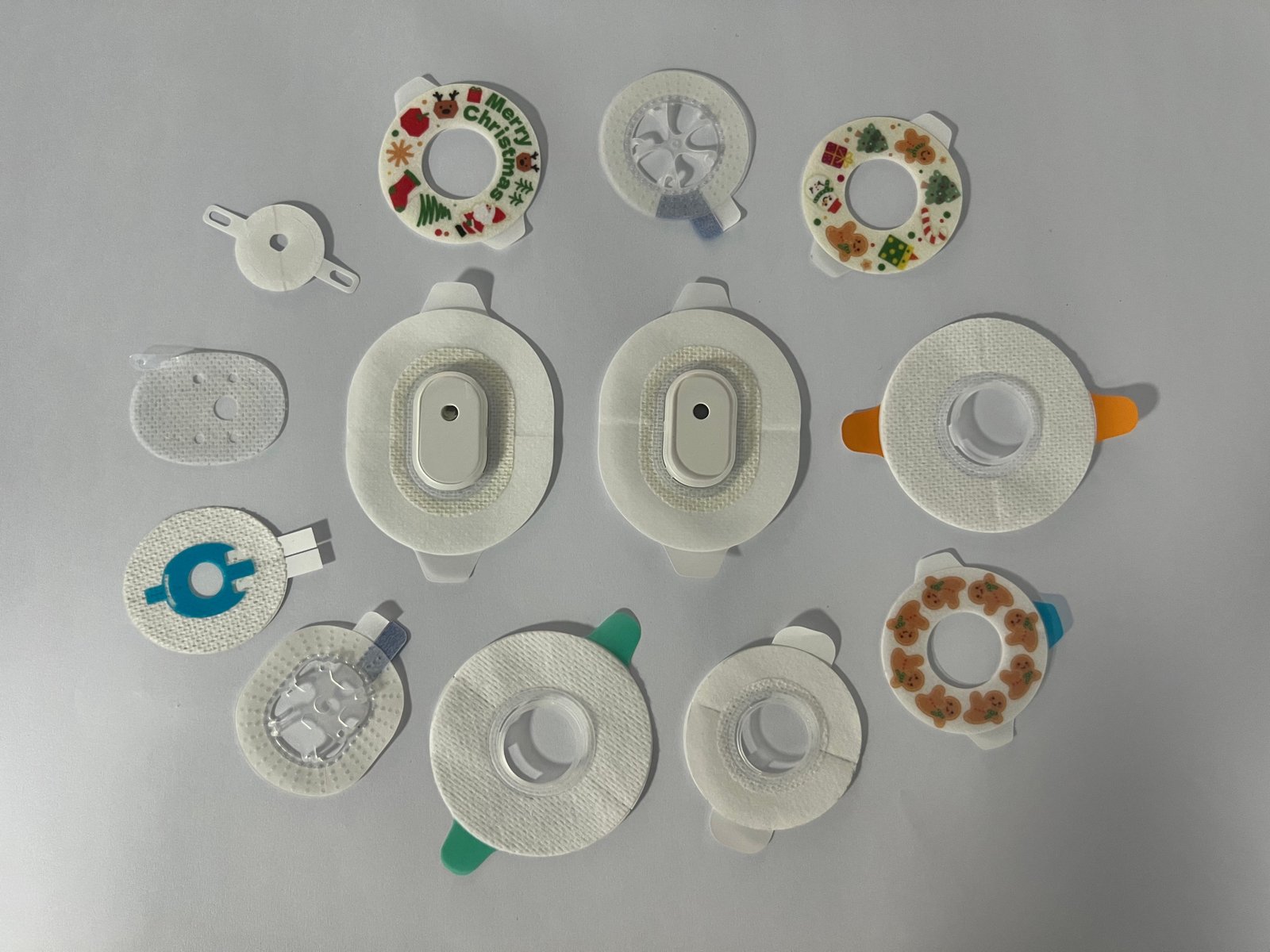
Geometry: Frame, Opening and Edge
The opening that surrounds the sensor is the most tolerance-sensitive feature on the whole patch. Too small and the patch fights the housing, tenting at the rim and lifting within hours. Too large and an adhesive-free gap forms around the housing, which collects moisture and debris.
Specify the opening diameter with an explicit micron tolerance rather than a nominal value with a general note. For a circular overpatch, the practical approach is to allow a controlled clearance of a few tenths of a millimetre beyond the housing and to hold that clearance concentrically, because an eccentric opening produces asymmetric lift.
Edge geometry matters just as much. A square corner concentrates stress and lifts first. A tapered or radiused edge distributes peel initiation across a longer path. Where the design allows, a small adhesive-free border or a thinner adhesive band at the outermost edge reduces the lint-collecting rim effect.
Material Stack Selection
Three families cover most overpatch constructions. Polyurethane film is thin, conformable and water resistant, and works well when the primary requirement is shower performance. Nonwoven constructions breathe and feel like fabric, which patients often prefer, but they wet out faster. Foam adds cushioning and abrasion resistance at the cost of thickness and breathability.
Thickness drives conformability. A 25 to 50 micron film drapes over the housing shoulder without a visible ridge, while thicker films bridge and create a peel front. For overpatches that must survive sport, a slightly thicker film with a tapered edge beats a thin film that tears at the cut line.
Adhesive Choice for Overpatches
The overpatch adhesive has a different job from the primary patch adhesive. It must resist shear for days under a housing load, tolerate moisture at the perimeter, and still remove without damaging skin that has already carried a sensor for a week.
Acrylic pressure-sensitive adhesives are the usual starting point because they deliver high shear strength and predictable converting at speed. Where skin sensitivity is the limiting complaint, a silicone skin-contact layer with an acrylic structural layer is a sensible hybrid: silicone at the perimeter, acrylic where the load is transferred.
Adhesive coat weight is a lever that is often overlooked. Increasing coat weight raises peel and shear but also raises removal trauma and residue. The correct value comes from static load testing on your actual housing mass, not from a data sheet maximum.
Breathability Versus Water Resistance
These two requirements are structurally opposed. A film that blocks liquid water also blocks moisture vapour, so sweat accumulates under the patch and macerates the skin. A breathable nonwoven lets vapour escape and also lets shower water in.
Three practical resolutions exist. Perforate the film to raise moisture vapour transmission while keeping a water-resistant matrix. Use a breathable nonwoven for the body of the patch and place a small water-resistant island only over the housing. Or accept moderate breathability and shorten the recommended wear window, which is a commercial decision rather than an engineering one.
What Converting Must Get Right
The first converting decision is process. Rotary die cutting holds registration and tolerance at volume and suits circular overpatches with a concentric opening. Flatbed cutting is more economical for short runs and complex outlines, and is often the right choice for clinical trial quantities.
The second is lamination. An overpatch is usually a two or three layer laminate, and each interface must be bonded without trapped air, because a bubble under a film becomes a visible defect and a peel initiation point. Layer registration between the opening and the outer profile must be controlled as a single operation, not as two.
The third is packaging. Overpatches are often packed individually or in strips, and the release liner must be stable enough that the patch does not shift or pre-release in the pouch.
Wear Validation That Means Something
Bench tests establish a baseline, not a result. Static shear on a defined substrate, peel adhesion at defined angles, and moisture vapour transmission rate are useful to compare designs, but they do not predict a fortnight on a moving patient.
Wear trials should specify activity level, showering frequency, skin type distribution and the definition of failure: edge lift beyond a stated distance, complete detachment, or sensor signal loss. Without a defined failure criterion, wear data cannot be compared between two designs.
For diagnostic detail on the mechanisms behind edge lift and patch detachment, our article on CGM patch failure causes covers the failure tree in depth. The broader material context sits in our medical materials library, and breathability mechanics are explained in the wearable breathability guide.
Frequently Asked Questions
Does every CGM device need an overpatch?
No. A device whose primary patch already covers the housing load and meets wear targets does not need one. Overpatches are justified when shear, water exposure or abrasion exceed what the primary patch was designed for.
What opening tolerance should an overpatch specify?
Define the clearance around the housing in microns, typically a few tenths of a millimetre, and require concentricity of the opening relative to the outer profile. Avoid percentage tolerances, which are not comparable between suppliers.
Is a waterproof overpatch better than a breathable one?
Water resistance and breathability conflict. For patients who shower frequently and sweat little, a film helps. For heavy sweat and sensitive skin, a breathable nonwoven with a small protected island is often better despite lower water resistance.
Can an overpatch cause more skin irritation than the primary patch?
It can, because two adhesive interfaces accumulate moisture and the overpatch is usually removed later, when the skin is already compromised. Lower coat weight and a silicone perimeter help, as does a defined wear limit.
How should overpatch performance be measured?
Combine bench peel and static shear with a wear trial that defines failure precisely: edge lift distance, detachment, or signal loss, recorded with activity and showering data. Without a failure definition the trial produces anecdotes.
Why does my overpatch lift at the corners?
Square corners concentrate peel stress. Radius the corner, taper the edge, and confirm the outer profile tolerance. Corner lift is a geometry problem far more often than an adhesive problem.
Conclusion
A high-performance overpatch is defined by three things: an opening that respects the housing without tenting, an edge that resists peel initiation, and a material stack whose breathability matches the wear window. Adhesive strength is necessary but not sufficient, and adding area to fix a shear problem usually creates a moisture problem instead.
Leetoya die-cuts CGM overpatches and primary patches from film, nonwoven and foam laminates under ISO 13485 in ISO Class 7 production, with concentric opening tolerance held as a single converting operation. See the custom CGM patch capability page for construction options.
Explore custom CGM adhesive solutions. Send the housing diameter, wear window and current failure mode, and we will propose an overpatch stack with matched opening tolerance. Request engineering support.