Most medical adhesive programs eventually face the same question: rotary or flatbed? The answer is rarely a matter of preference. It is a break-even calculation with a tolerance constraint attached, and the two are often in conflict, because the process that is cheapest at low volume is not the process that holds the tightest tolerance at high volume.
This article sets out the cost structure behind each route, the tolerance behaviours that differ, and the hybrid approach that most programs should consider before committing to tooling.
Frame the Decision Around Three Numbers
Three inputs decide the route before any quote is requested: annual volume, expected design stability, and the tightest feature tolerance on the part. Volume sets how quickly tooling is absorbed. Design stability sets how much risk sits in a non-recoverable die. Tolerance sets whether the cheaper process is even admissible.
A program with 200,000 units per year, a locked design and a plus or minus 0.1 mm profile tolerance is a rotary candidate. A program with 8,000 units, three expected revisions and an intricate outline is a flatbed candidate. Most programs sit between those extremes and need a staged answer.
Tooling Cost Structure
Rotary tooling is a machined cylinder, usually hardened steel, with the cutting geometry produced to the part drawing. The cost is driven by circumference, number of cavities, feature complexity and the finishing operations needed to hold tolerance. Lead time is measured in weeks, and any geometry change after qualification usually means re-machining or a new cylinder.
Flatbed tooling can be a machined steel die for long-life work or a chemically etched flexible die mounted on a magnetic cylinder. Flexible dies are inexpensive and fast, which makes them attractive for prototypes, clinical trial quantities and early production. Their limitation is wear: at high impression counts they lose edge sharpness faster than a hardened rotary die.
The comparison to make is not tooling price but cost per qualified part. A cheap flexible die that requires replacement three times during a campaign can cost more than a rotary cylinder that runs the whole program.
Tolerance and Registration Behaviour
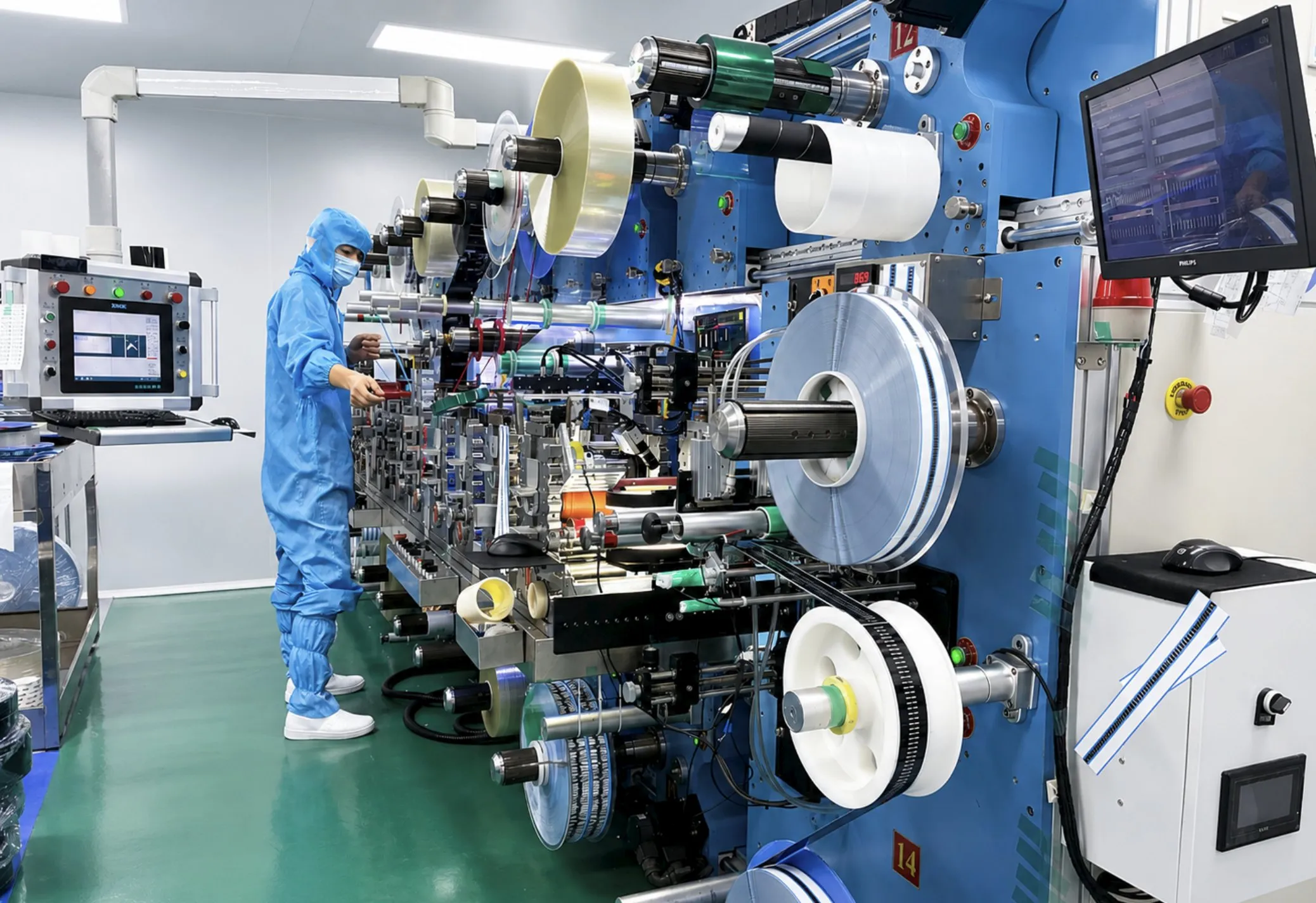
Rotary cutting is a continuous process. The web moves at constant tension and the die rotates in registration with printed fiducials, so the cut position relative to print stays stable over long runs. That stability is what allows tight registration on features such as sensor openings, where the tolerance may be a few tenths of a millimetre and the consequence of drift is a patch that tents or leaks.
Flatbed cutting is a stroke process. Each stroke introduces a small positional variation, and on multi-layer or thick stacks the stroke can compress the material before cutting, which changes the effective dimension. Flatbed can hold good tolerance on rigid or single-layer work and is excellent for complex outlines, but the registration stability at speed is lower.
Kiss-cut depth control also differs. Rotary dies control depth mechanically through cylinder geometry and are highly repeatable. Flatbed depth depends on press setup and platen parallelism, and is more sensitive to operator setup and material thickness variation.
Material Yield and Nesting
Adhesive roll stock is expensive, and yield is decided by how well the parts nest on the web width. Rotary tooling is built for a specific web width and cavity count, so a design that leaves dead space on the web carries that inefficiency for the life of the tool.
Flatbed work can be laid out on sheets with different nesting, which is more forgiving for awkward outlines and small quantities. But sheet-fed adhesive work often requires a liner handling step, which adds labour.
Ask any supplier to show the web layout and the resulting yield percentage. A quote that does not state yield is a quote that has not been engineered.
Variants, Revisions and Change Cost
Adhesive component programs usually have variants: different sizes, different liner splits, different printed branding, different opening diameters. On a rotary tool each variant is usually a separate cylinder or a separate cavity, so a variant strategy multiplies tooling cost.
Flatbed and flexible dies make variants cheaper to add, which is why early-stage programs with a family of sizes often start there. The trade is that once the family stabilises, the per-part cost of flatbed production becomes the constraint.
Break-Even Reasoning
The break-even point is where tooling differential divided by per-part saving equals the volume. In practice, request quotes at three volumes: a trial quantity, a first-year forecast and a mature-year forecast. The break-even is visible in the price curve, and it is usually well below the volume teams expect.
Two adjustments matter more than the arithmetic. First, count the cost of qualification: a process change after design freeze triggers new first-article inspection, capability studies and sometimes regulatory documentation. Second, count scrap during ramp, which is higher on a new rotary tool than on a flexible die.
The Hybrid Ramp
The pragmatic route for most medical adhesive programs is staged. Use flatbed or flexible-die cutting for design verification and clinical quantities, where speed and low tooling risk dominate. Freeze the design after wear and usability data, then invest in rotary tooling for launch and serial production, keeping the flexible die as a bridge for variants.
This approach requires the supplier to support both routes with the same quality system and the same inspection methodology, otherwise the transfer between them introduces variation that looks like a design change. Ask explicitly how the transfer is validated.
For a process-level view of both routes and how they compare to laser cutting, see our precision die cutting process guide. The existing rotary versus flatbed technical comparison covers the mechanical differences in more depth.
Frequently Asked Questions
At what volume does rotary die cutting become cheaper than flatbed?
It depends on tooling complexity and part size, but the break-even is usually reached earlier than teams expect when qualification and scrap costs are included. Ask for quotes at three volumes to see the actual crossover.
Which process holds tighter tolerance on adhesive parts?
Rotary, because continuous web tension and vision registration keep the cut position stable across a long run. Flatbed is better for complex outlines but has more per-stroke variation.
Can a flexible die be used for production?
Yes, for moderate volumes and where tool life is monitored. At high impression counts, edge wear becomes a quality variable and hardened rotary tooling is the more stable choice.
What changes when moving from flatbed to rotary mid-program?
New tooling, new first article inspection, potentially new capability data, and a transfer validation to prove the part did not change. The design should be frozen before the transfer.
How does liner choice affect the process decision?
Kiss cutting demands precise depth control, which rotary handles more repeatably. Liner type also affects whether parts can be wound after cutting or must be handled individually.
Should variants share one tool?
Often no. Each variant usually needs its own cavity or cylinder, so a variant family can multiply tooling cost. Flexible dies make variant iteration cheaper during development.
Conclusion
Rotary wins on tolerance stability and unit cost at volume. Flatbed wins on tooling cost, flexibility and complex outlines. The expensive mistake is choosing either route on a single quote rather than on a three-volume price curve with qualification costs included.
Leetoya operates rotary and flatbed die cutting in parallel, with flexible-die ramp support for design iterations and hardened tooling for serial production. See rotary die cutting and flatbed die cutting capabilities.
Request a quote at three volumes. Send the drawing and trial, first-year and mature-year quantities, and we will return a price curve with the tooling break-even stated. Contact our engineering team.