جدول المحتويات
- لماذا تهمّ مراقبة الجودة
- إطار مراقبة الجودة
- طرق الفحص أثناء العملية
- اختبار المواد والأداء
- قابلية التتبع والوثائق
- أبرز موضوعات القطاع لعام 2026
- FAQ
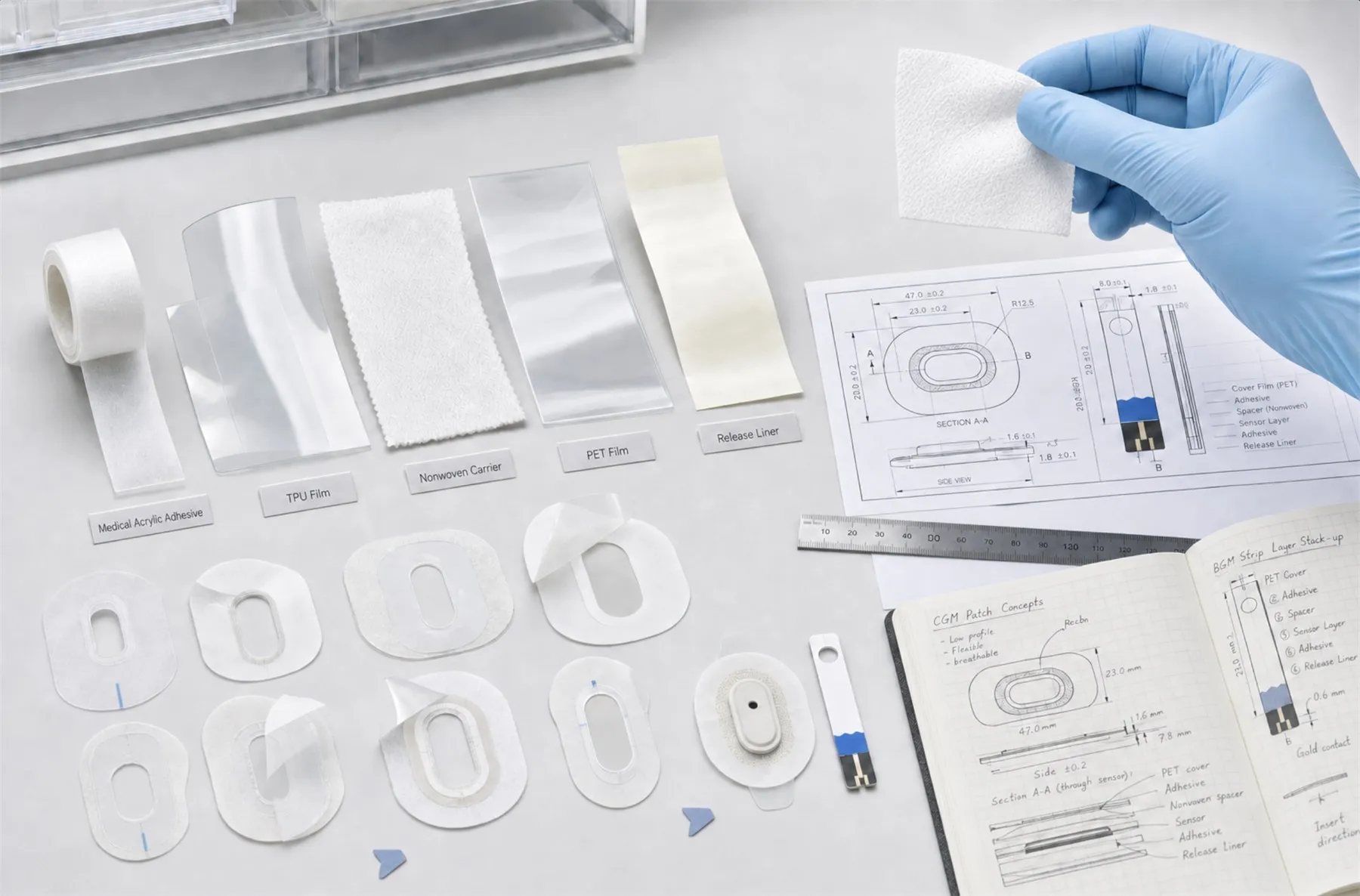
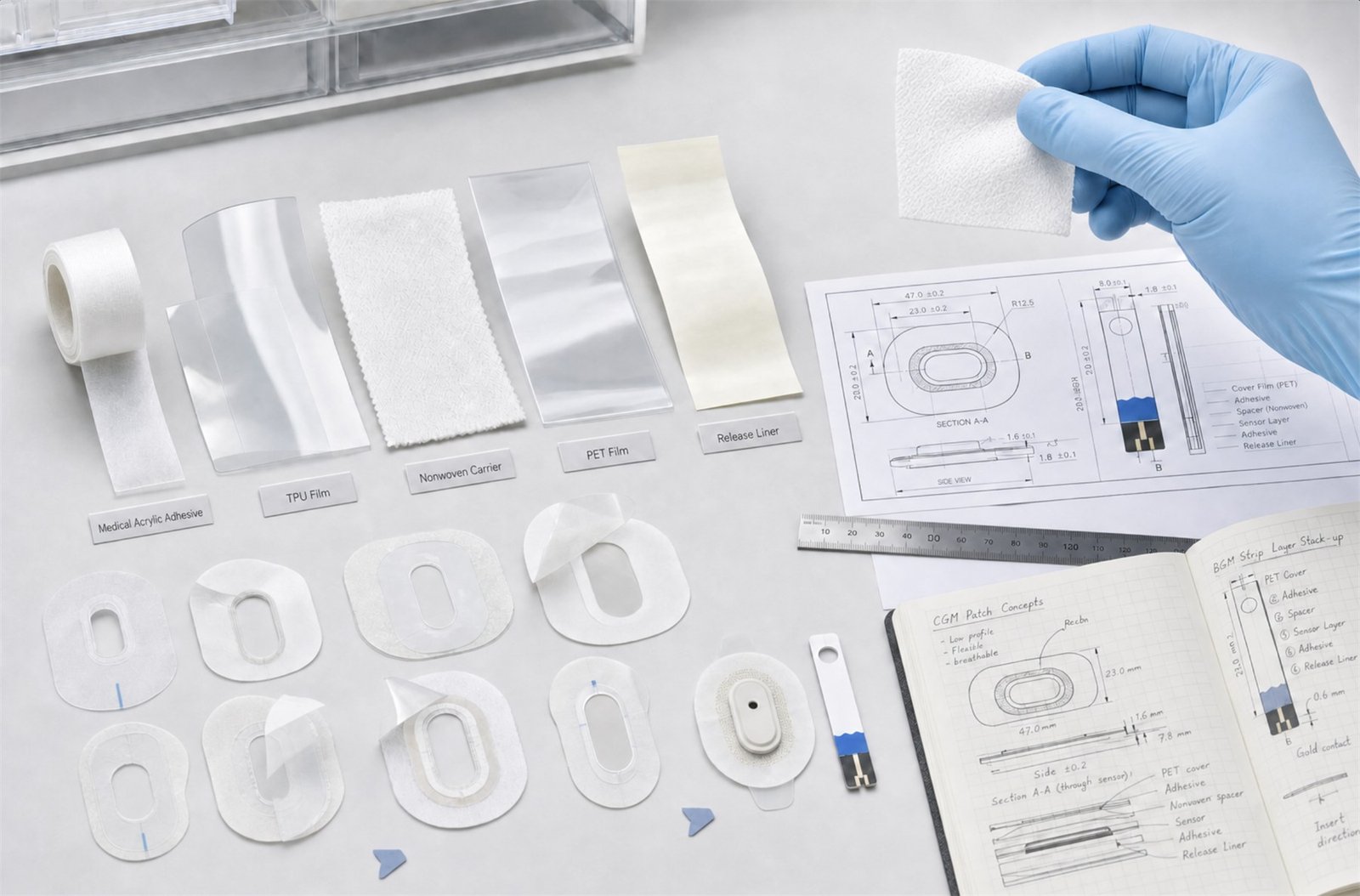
مراقبة الجودة في تصنيع مكوّنات الأجهزة الطبية هو العمود الفقري للامتثال التنظيمي وسلامة المرضى. ومن أجل مكوّنات لاصقة طبية مقطوعة بالقوالب بدقة, robust QC ensures every batch meets exact specifications and that deviations are caught before they reach the patient. This guide outlines the QC framework, inspection methods, and documentation required for medical adhesive converting.
Why Quality Control Matters
A single out-of-tolerance component can cause device failure, patient harm, or costly recalls. Consider these examples:
- For CGM patches, a spacer tape 20 micrometers too thick can alter the sensor-to-skin distance, compromising glucose reading accuracy.
- For BGM test strips, a misaligned adhesive layer can create air gaps that affect reagent distribution.
- For insulin pump adhesives, edge lifting can lead to premature detachment and missed insulin doses.
Rigorous QC operates under an ISO 13485 certified quality system, where every process is documented, validated, and continuously monitored.
The QC Framework
A comprehensive QC program for medical adhesive converting includes five interconnected layers:
- Incoming Material Inspection: Every raw material lot (adhesive roll, film, liner) is inspected for thickness, width, appearance, and conformance to specifications before entering production.
- First Article Verification: The first pieces of every production run are measured and approved before full production begins.
- In-process Monitoring: Critical dimensions and visual quality are checked every 100-500 pieces during production.
- Final AQL Sampling: Completed batches are statistically sampled per ANSI/ASQ Z1.4 (typically AQL 0.65 critical / 1.5 major).
- Documentation Review: All records are reviewed and approved before the batch is released for shipment.
In-Process Inspection Methods
Modern medical converters use a combination of automated and manual inspection:
| Method | What It Checks | Speed |
|---|---|---|
| Machine Vision Cameras | Dimensions, shape, defects, labels | 100% inspection, every piece |
| Laser Micrometers | Thickness during lamination | Real-time, continuous |
| Microscope Inspection | Edge quality, burrs, adhesive bleed | Sampling |
| Peel Testing | Adhesion strength per PSTC standards | Per batch |
| Cleanroom Monitoring | Particles, temperature, humidity | Continuous |
Machine vision has become increasingly important as volumes grow. Modern systems can detect defects as small as 10 micrometers at production speed, catching issues that human inspectors might miss.
Material and Performance Testing
Beyond visual and dimensional inspection, medical adhesive components require performance testing:
- Peel Adhesion: Measured per ASTM D3330 / PSTC-101 at 180-degree angle. Ensures bond strength meets design requirements.
- Shear Holding: ASTM D3654 / PSTC-107 measures how long the adhesive holds under static load.
- Tack: Rolling ball or probe tack tests measure initial adhesion.
- Thickness: Micrometer or laser measurement at multiple points.
- Visual Appearance: Color, clarity, surface defects, foreign material.
See our material solutions for typical test data sheets on available adhesive systems.
Traceability and Documentation
Every batch of medical adhesive components produced under ISO 13485 includes complete traceability documentation:
- Raw material lot numbers (adhesive, film, liner, release paper)
- Production date and time, operator ID, machine ID
- Die or tool ID and last maintenance date
- Process parameters (temperature, pressure, speed, line tension)
- In-process inspection results and charts
- Final AQL sampling results
- Cleanroom environmental monitoring logs
- Certificate of Conformance (CoC)
This documentation package supports FDA 510(k) submissions, EU MDR technical files, and customer audits. In the event of a field issue, full traceability enables rapid, targeted recalls rather than blanket market withdrawals.
2026 Industry Hot Topics
The medical adhesive converting industry is evolving rapidly. These trends are shaping quality control approaches in 2026:
- AI-Powered QC: Machine learning algorithms now detect subtle defects that traditional rule-based vision systems miss. Models are trained on thousands of defect images to identify novel defect types.
- Sustainable Materials: Growing demand for recyclable and biodegradable medical adhesives requires new QC protocols for material consistency and end-of-life considerations.
- Personalized Medicine: Custom-fit components (patient-specific patches) require flexible production with QC protocols that adapt to variable designs.
- Supply Chain Resilience: Dual-sourcing critical components and materials has become standard after recent supply disruptions. QC must handle multiple supplier sources.
- Digital Twin Manufacturing: Companies are simulating die cutting and lamination processes virtually before physical runs, reducing first-article defects.
- Real-Time Release: Advanced monitoring systems now enable statistical release of batches without traditional AQL sampling, reducing lead times.

FAQ
What AQL level should be used for medical components?
Most medical device components use AQL 0.65 for critical defects and AQL 1.5 for major defects per ANSI/ASQ Z1.4. Your quality agreement with the device manufacturer will specify the exact levels.
What is the difference between QA and QC?
Quality Assurance (QA) builds quality into the process — SOPs, training, process validation, and system design. Quality Control (QC) verifies that quality has been achieved through inspection and testing. Both are required under ISO 13485.
Do you provide a Certificate of Conformance with every shipment?
Yes. Every ISO 13485 certified shipment includes a Certificate of Conformance documenting the batch, material lots, test results, and release authorization. Contact us for sample documentation.
How often are your cleanrooms monitored?
Particle count, temperature, and humidity are monitored continuously and logged automatically. Formal weekly and monthly reports are available upon request.
Leetoya operates under ISO 13485 with machine vision QC, full traceability, and continuous cleanroom monitoring. Learn about our quality commitment or request our QC documentation package.