Insulin pump adhesive components are the fixation layer that keeps a wearable insulin delivery system seated firmly against the body through daily movement, sleep, exercise and clothing contact. Unlike a decorative or packaging sticker, a pump patch must carry module weight, protect the infusion site, conform to skin contours and remove without trauma at end of wear. This article explains how these components are engineered: the multilayer structure, skin-contact adhesive selection, load-bearing carrier and foam layers, liner and converting precision, and the cleanroom production and packaging controls that keep each component consistent at scale.
Table of Contents
- What Insulin Pump Adhesive Components Must Deliver
- The Multilayer Structure of a Wearable Pump Patch
- Skin-Contact Adhesive Selection and Wear Conditions
- Carrier, Foam and Backing: Load-Bearing Layers
- Release Liners, Die Cutting and Assembly Precision
- Cleanroom Production, Packaging and Traceability
- Frequently Asked Questions
What Insulin Pump Adhesive Components Must Deliver
Wearable insulin delivery systems place a demanding set of requirements on their fixation components. The patch anchors the pump module or infusion set to the skin, keeps the site stable during walking, bending and sleeping, and resists lift from sweat, showering and friction against waistbands or sleeves. Because the device is worn continuously over an extended period, the adhesive must also remain comfortable and gentle enough that removal does not damage fragile skin, especially where users change sites repeatedly over months and years of therapy.
The component sits within the broader diabetes device ecosystem. Continuous and intermittent monitoring—covered in our diabetes monitoring application overview—shares the same skin-contact engineering challenges: secure wear, breathability and safe removal. For pump systems specifically, the patch may need to accommodate module geometry, cable or cannula routing, and pressure points where the device contacts the body. Each of these functions is designed into the laminate stack rather than improvised at assembly.
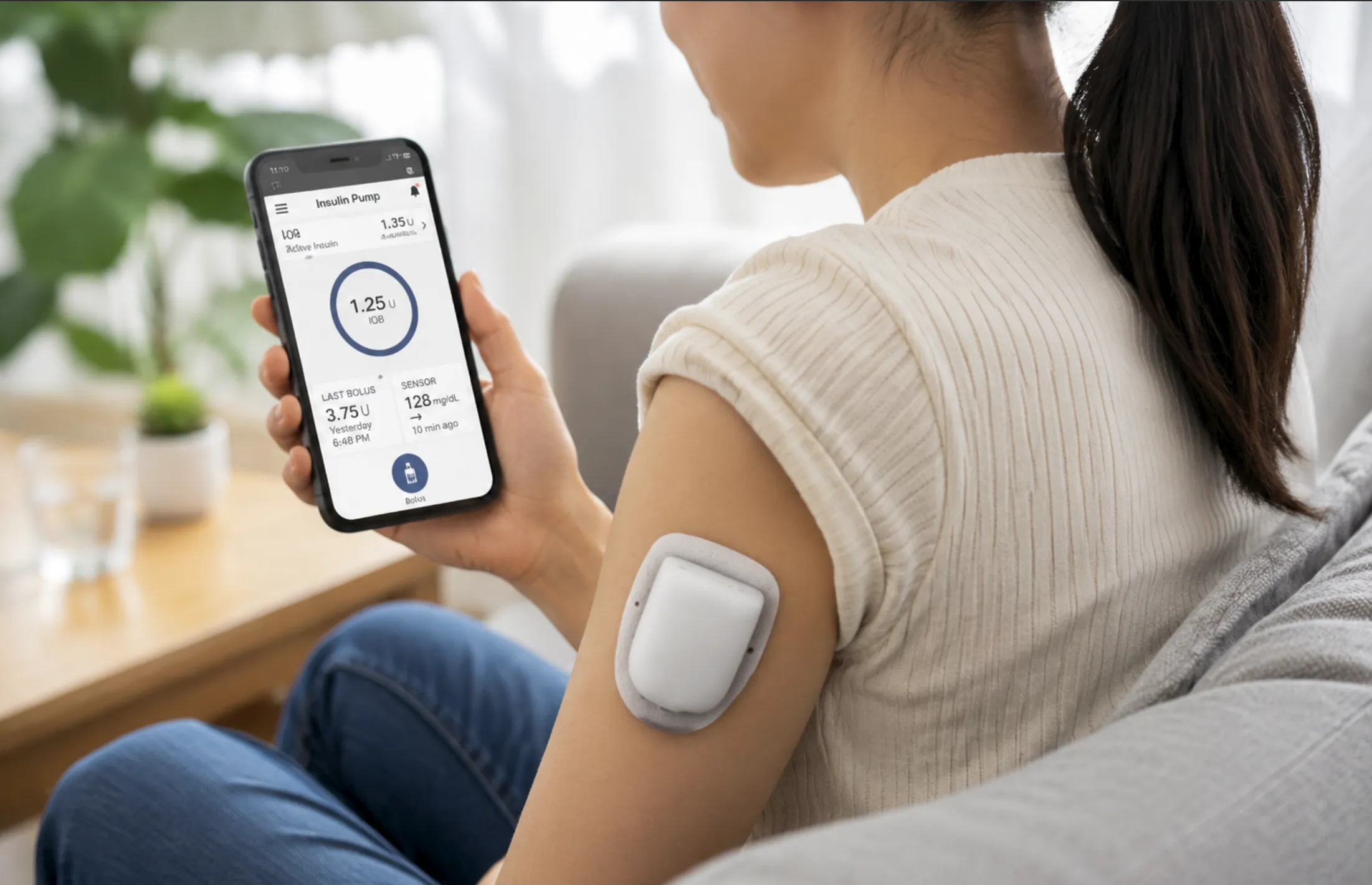
Failure modes in pump fixation are unforgiving: edge lift can dislodge the device, trapped moisture can irritate the skin, and an overly aggressive adhesive can make site changes painful. The engineering goal is therefore not maximum adhesion alone, but a balanced bond that holds through the intended wear window and releases predictably at removal. This balance is built through material choice, layer structure, die geometry and validated converting processes.
The Multilayer Structure of a Wearable Pump Patch
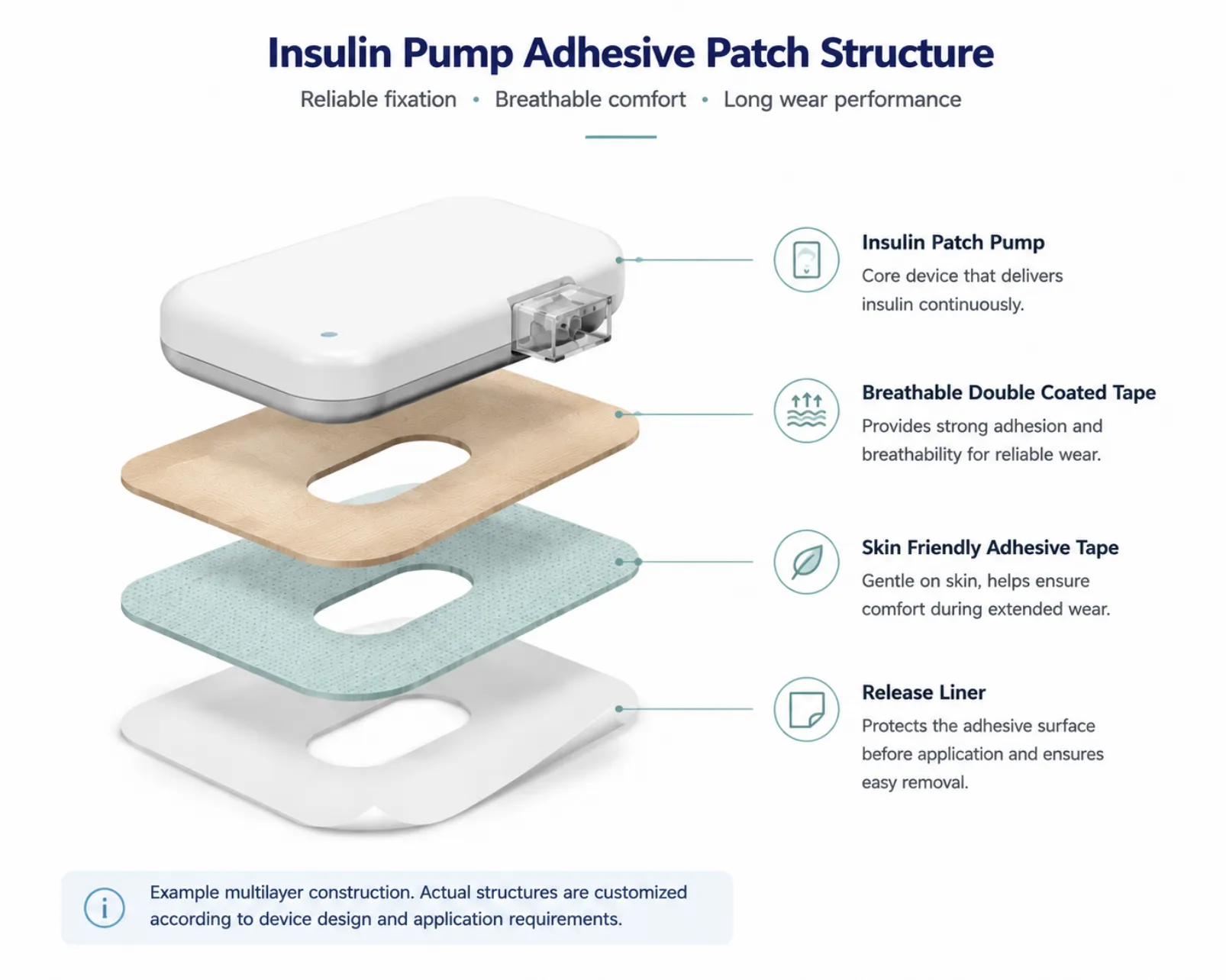
A pump adhesive component is almost never a single adhesive-coated sticker. It is a designed laminate in which each layer performs a specific role in fixation, cushioning, protection or assembly. The table below describes the typical layer stack and its function.
| Layer | Typical material / form | Function in the pump patch |
|---|---|---|
| Release liner | Coated paper or film liner, split or scored as required | Protects the adhesive before application; peels away cleanly at device assembly or user application |
| Skin-contact adhesive | Medical-grade acrylic or silicone pressure-sensitive adhesive | Forms the bond to skin; controls peel force, tack and removal gentleness for the wear window |
| Carrier / backing | Nonwoven, film or hybrid carrier | Carries mechanical load, distributes stress around the module, provides conformability and print surface |
| Foam or cushioning layer | Medical foam | Absorbs pressure where the module presses into skin, adds comfort and helps distribute the device's weight |
| Reinforcement / overlay region | Reinforced film or nonwoven around the device seat | Strengthens the attachment point where module weight concentrates and resists localized peeling |
| Perimeter and geometry | Die-cut outline with optional relief cuts | Matches body site and device shape; reduces edge lift at bending and high-friction areas |
The exact stack varies by device: a lightweight patch may rely on adhesive and carrier alone, while a heavier module uses foam cushioning and a reinforced seat. Layer order, coat weight and liner release force are specified against the device's weight, wear target and skin-contact class during development.
Skin-Contact Adhesive Selection and Wear Conditions
The skin-contact adhesive is the layer users feel most directly. Selection begins with the intended wear duration, body site and skin characteristics: areas prone to sweat or movement need a secure bond, while sensitive or frequently rotated sites favor gentle removal. Acrylic pressure-sensitive adhesives offer strong, predictable adhesion and cost efficiency for stable fixation; silicone adhesives are chosen where gentle lift-off, repositioning and comfort are prioritized. Coat weight is tuned so the adhesive grips without oozing residue or becoming excessively aggressive at removal.
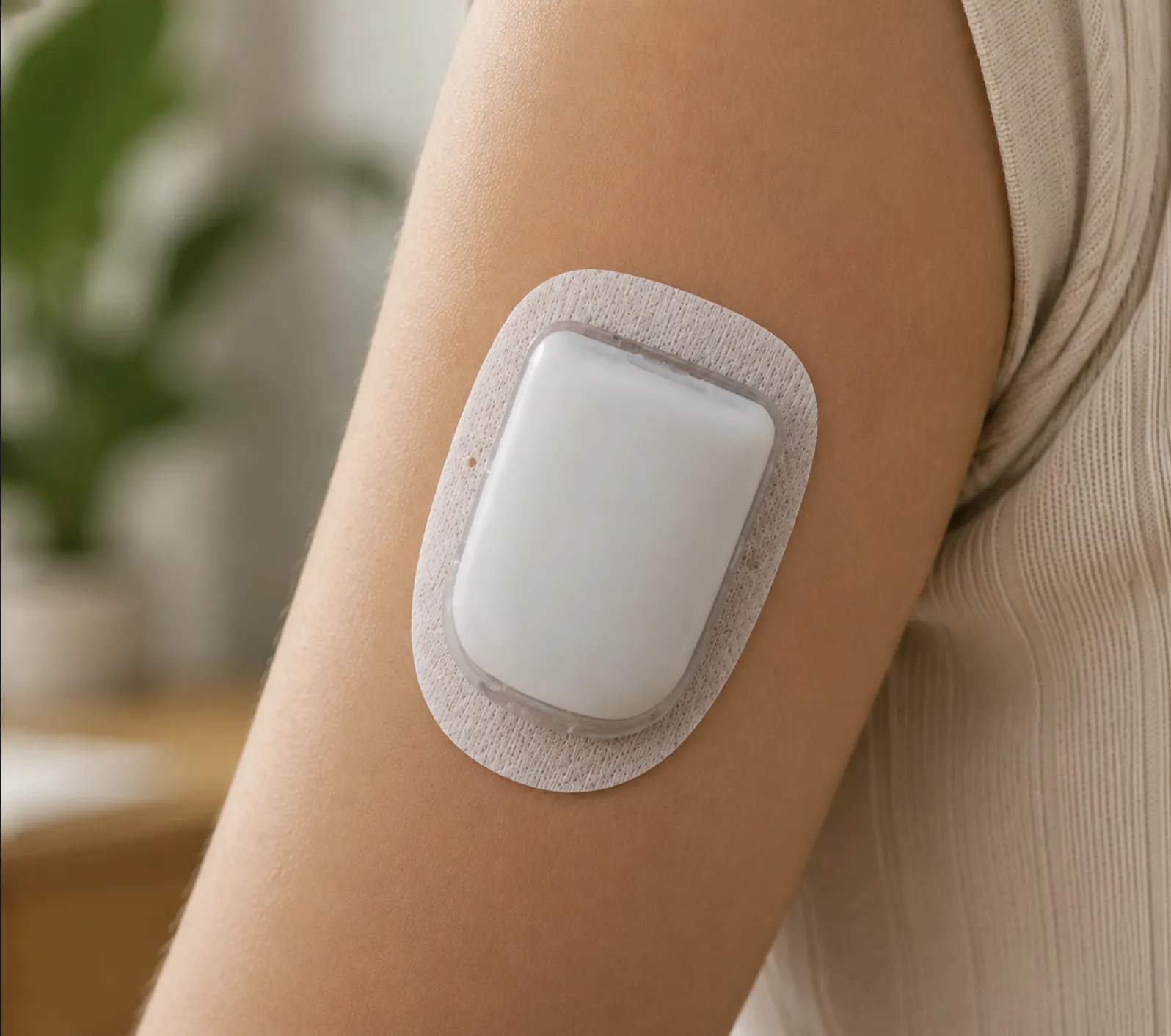
Wear conditions are tested realistically rather than in abstract. Sweating, showering, clothing friction, sleeping position and body movement all affect bond retention, so prototypes are evaluated for edge lift, shear, residue and skin appearance across the planned wear window. Site rotation—standard practice in insulin therapy—also matters: adhesive that holds securely on first application should remain tolerable when used repeatedly at neighboring sites. The adhesive grade, backing and liner are adjusted together because changing one layer changes how the bond behaves on skin.
Carrier, Foam and Backing: Load-Bearing Layers
While the adhesive bonds to skin, the carrier and foam layers carry the device. The backing or nonwoven carrier distributes module weight across a wider area so stress does not concentrate at the sensor or cannula seat, and it flexes with skin movement to prevent edge peeling. Flexible film backings offer a smooth, conformable surface; nonwoven backings provide a textile-like feel and breathability that many long-wear users prefer. Where the module presses into the body, medical foams add cushioning that spreads pressure and improves comfort without adding bulk.
The backing also determines how the patch looks and handles in production: it accepts printing where branding or application instructions are required, supports reinforcement overlays, and forms the die-cut perimeter that fits the chosen body site. Selecting these layers is a balance between stiffness for shear strength and softness for comfort—too rigid a backing lifts at curves; too soft a backing lets the module shift. Our medical adhesive materials platform combines adhesives, nonwovens, films, foams and liners so the laminate can be assembled from compatible, documented grades.
Release Liners, Die Cutting and Assembly Precision
Every adhesive component reaches the user protected by a liner. Release liners must release cleanly at the right moment—during device assembly or when the user applies the patch—without leaving silicone or coating residue on the adhesive, tearing, or sticking where it should peel. Liner release force is matched to the adhesive and to whether the patch is supplied as a single unit, a split liner for two-handed application, or a rewound format for automated assembly.
Converting precision determines whether that design works in practice. Rotary, flatbed or laser die cutting defines the patch outline, internal openings and any kiss cuts or island placements; registration between layers must hold across the laminate so adhesive, carrier and foam align with the device seat. Edge quality affects both appearance and lift resistance: clean, controlled edges reduce the chance of catching on clothing and peeling outward. For pump patches that ship as part of a finished device, these converted components are then readied for packaging and assembly steps such as welding, bagging, counting and rewinding, under controlled records.
Cleanroom Production, Packaging and Traceability
Insulin delivery components are skin-contact medical parts, so production runs under controlled converting conditions with documented quality controls. Materials are qualified and traced by lot, converting runs are recorded against the part specification, and inspection checks geometry, adhesive placement and edge quality before release. Packaging protects the sterile-or-clean condition of the patch through storage and shipping, and records link each finished component back to its incoming material lots for traceability in case of review or investigation.
This production discipline supports the device manufacturer's own regulatory file: consistent components, controlled materials and traceable records are what make a fixation patch dependable across millions of units. If you are developing a wearable pump patch or infusion-set fixation component, our team can review your geometry, wear target and skin-contact requirements, then convert prototype samples and scale to production under the same controlled process. Request a quote or engineering review with your drawings or concept description, and we will outline the material and converting plan for your insulin pump adhesive components.
Frequently Asked Questions
What is the difference between a CGM patch and an insulin pump adhesive component?
A CGM patch primarily secures a monitoring sensor to the skin and protects its attachment site; an insulin pump adhesive component secures a delivery module or infusion set, which often carries more weight and may need to accommodate cannula or cable routing. Both share skin-contact adhesive and backing engineering, but the pump patch is engineered for module load, pressure cushioning and device-specific geometry.
How long should an insulin pump patch stay attached?
Wear duration depends on the device design, adhesive grade, body site, sweat and activity level, and it must be validated through wear testing for the specific product. Engineering targets are set during development, and the adhesive, carrier and foam stack are chosen to meet that target through the full wear window rather than relying on initial tack alone.
Which adhesive is gentlest for repeated pump site changes?
Silicone adhesives are commonly selected for gentle removal and repeated handling, while acrylic adhesives offer strong, cost-effective fixation. The gentlest option for a given user population depends on skin condition, wear time and removal frequency, so grade selection should be confirmed through prototype and wear evaluation rather than assumed.
Why is foam included in some pump patches?
Foam cushions the area where the module presses into the skin, spreads device weight, reduces pressure points and improves comfort during extended wear. It is used where module weight or geometry would otherwise concentrate stress on a small skin area; lighter patches may not need a foam layer.
How are pump adhesive components packaged after converting?
Converted patches may be bagged, counted, welded, rewound or assembled according to the device manufacturer's requirements, with packaging chosen to protect adhesive and liner through storage and shipping. Lot records link the finished component to its material batches, supporting traceability and quality review.