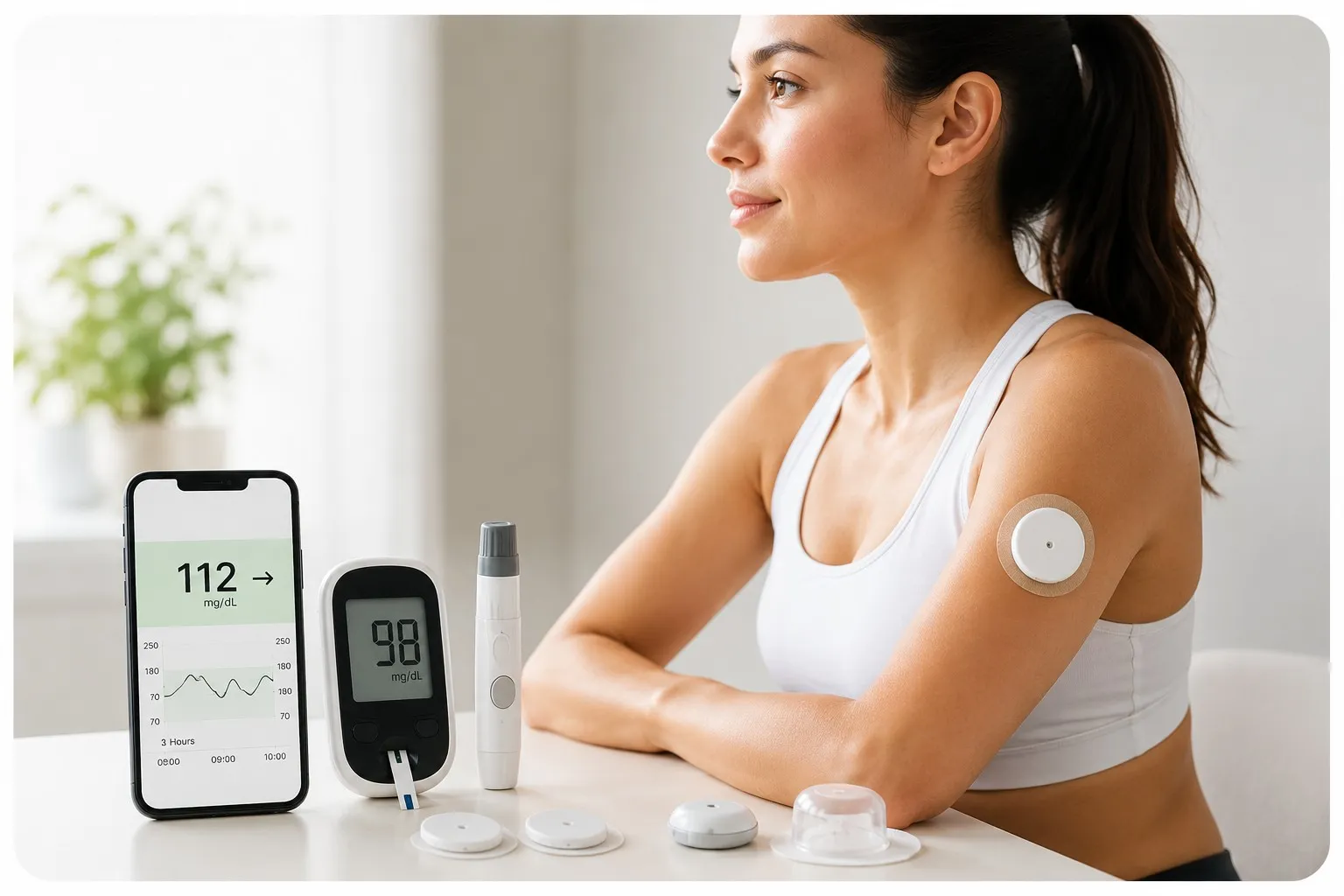
A CGM patch has to do two jobs at once. It has to hold a sensor housing against the skin for seven to fourteen days, and it has to let the skin underneath keep working. Most sourcing conversations focus on the first job — peel adhesion, shear resistance, initial tack — because those numbers are printed on every material datasheet. The second job is where most field complaints actually come from: itching, redness, edge lift after a shower, and the tell-tale ring of macerated skin left behind when the patch finally comes off.
Breathability is the engineering variable that connects those complaints to a material specification. It is usually described as moisture vapor transmission rate (MVTR), and it interacts with adhesive chemistry, backing choice, liner, patch geometry and the converting process itself. This article sets out how moisture behaves under a wearable patch, which layers decide the outcome, and what to specify and test when you are qualifying a custom CGM adhesive patch supplier.
Table of Contents
- Why Breathability Becomes the Limiting Factor in Long Wear
- What MVTR Actually Measures — and What It Does Not
- The Occlusion Problem: Moisture, Heat and Skin Barrier Damage
- Layer by Layer: Where Breathability Is Won or Lost
- Balancing Breathability Against Adhesion and Conformability
- Breathable Constructions in Practice
- Converting Considerations: Lamination, Perforation and Cleanroom Control
- Test Methods and What to Ask a Converter For
- Common Failure Modes and Their Root Causes
Why Breathability Becomes the Limiting Factor in Long Wear
Skin continuously loses water. Even at rest, transepidermal water loss sits in the range of a few grams per square metre per hour; under occlusion, with sweat glands active and a housing trapping heat, the local humidity between skin and adhesive can approach saturation within hours. An adhesive that is comfortable for a two-day wear test can behave completely differently on day ten, because the substrate underneath it has been wet the entire time.
That is why breathability is best treated as a wear-duration specification rather than a nice-to-have. Devices designed for three days can tolerate a fairly occlusive construction. Devices designed for fourteen days usually cannot, unless the patch area is small, the patient population has low sweat rates, or the design deliberately moves moisture away from the skin through an absorbent island.
What MVTR Actually Measures — and What It Does Not
MVTR is a steady-state flux measurement: how much water vapor passes through a unit area of material per unit time under specified temperature and humidity. Values are commonly reported in g/m²/24h, and the test conditions matter as much as the number. A material quoted at 38 °C and 90% relative humidity is not comparable to one quoted at 23 °C and 50% RH, yet both appear in the same column of the same datasheet format.
Two practical caveats follow. First, MVTR describes a flat, unstrained specimen, while a patch on a moving shoulder or abdomen is curved and partly stretched, which changes the effective path length for vapor. Second, MVTR says nothing about lateral moisture spread. A high-MVTR backing with a thick, occlusive adhesive layer can still trap water at the interface, because the vapor has to diffuse through the adhesive first. Ask for the value of the finished laminate, not only the backing film.

The Occlusion Problem: Moisture, Heat and Skin Barrier Damage
When water cannot leave, the stratum corneum hydrates and swells. Swollen skin is softer, more easily damaged by repeated adhesive removal, and more vulnerable to friction from the patch edge. Hydration also plasticizes the adhesive itself: acrylics lose cohesive strength as they absorb water, which shows up as residue on the skin and as a patch that creeps under a housing load.
Heat compounds the effect. A sensor housing plus an overpatch creates a small insulated zone; skin temperature rises, sweat rate rises, and the adhesive softens at the same time. This is why breathability problems appear first in summer months, in active patients, and under the housing rather than at the patch edge. It is also why an adhesion and wear performance review that ignores moisture will usually recommend a stronger adhesive when the correct answer is a more breathable construction.
Layer by Layer: Where Breathability Is Won or Lost
Start from the skin and work outward. The skin-contact adhesive is often the biggest resistance in the stack, particularly when it is a continuous coat weight of 50–100 g/m² of acrylic gel. Pattern coating, lower coat weight, or a perforated adhesive can raise transmission substantially without changing the backing.
The backing or carrier comes next. Spunlace and nonwoven fabrics are inherently porous and transmit well; monolithic polyurethane films transmit by diffusion and can be engineered to a target MVTR; solid PET transmits very little and is usually chosen for dimensional stability instead. Then come the housing, the overpatch and any printing or coating on top, each of which can close the path again. A useful discipline is to request MVTR for every layer and for the finished laminate, then compare the finished value against the wear duration target.
Balancing Breathability Against Adhesion and Conformability
Every gain in breathability costs something. Perforating the backing improves transmission but reduces the area available for adhesion and creates stress concentrations at hole edges. Lowering adhesive coat weight reduces moisture resistance but also reduces peel and shear. Thinner films conform better and feel lighter, yet they are harder to convert without stretch and web distortion.
The usual resolution is a hybrid: a perforated or high-MVTR backing combined with a patterned adhesive, an absorbent or hydrocolloid island over the most occluded region, and a slightly larger patch footprint to recover the adhesion lost to perforation. That combination is a converting problem as much as a materials problem, and it is worth discussing with a cleanroom converting partner before the design is frozen.
Breathable Constructions in Practice
Four families dominate. Perforated nonwoven tapes offer the highest transmission at low cost and are widely used on CGM overpatches. Monolithic PU film laminates give a smooth, thin, printable surface with tunable MVTR and good conformability, which suits device patches that carry branding and a housing. Knitted or woven elastic fabrics provide stretch and recovery for joints and high-motion sites. Hydrocolloid and foam constructions absorb moisture rather than transmit it, which is the right answer when sweat volume is high and the wear site cannot be ventilated.
Selection should follow wear site and activity level first, then the device's mechanical load, then aesthetics. A breathable film that cannot carry the housing torque is not a solution; a heavy nonwoven that transmits well but lifts at the edges under tubing pull is equally wrong. Table-style comparison of candidate stacks, rather than a single-material decision, is the fastest route to a workable design.
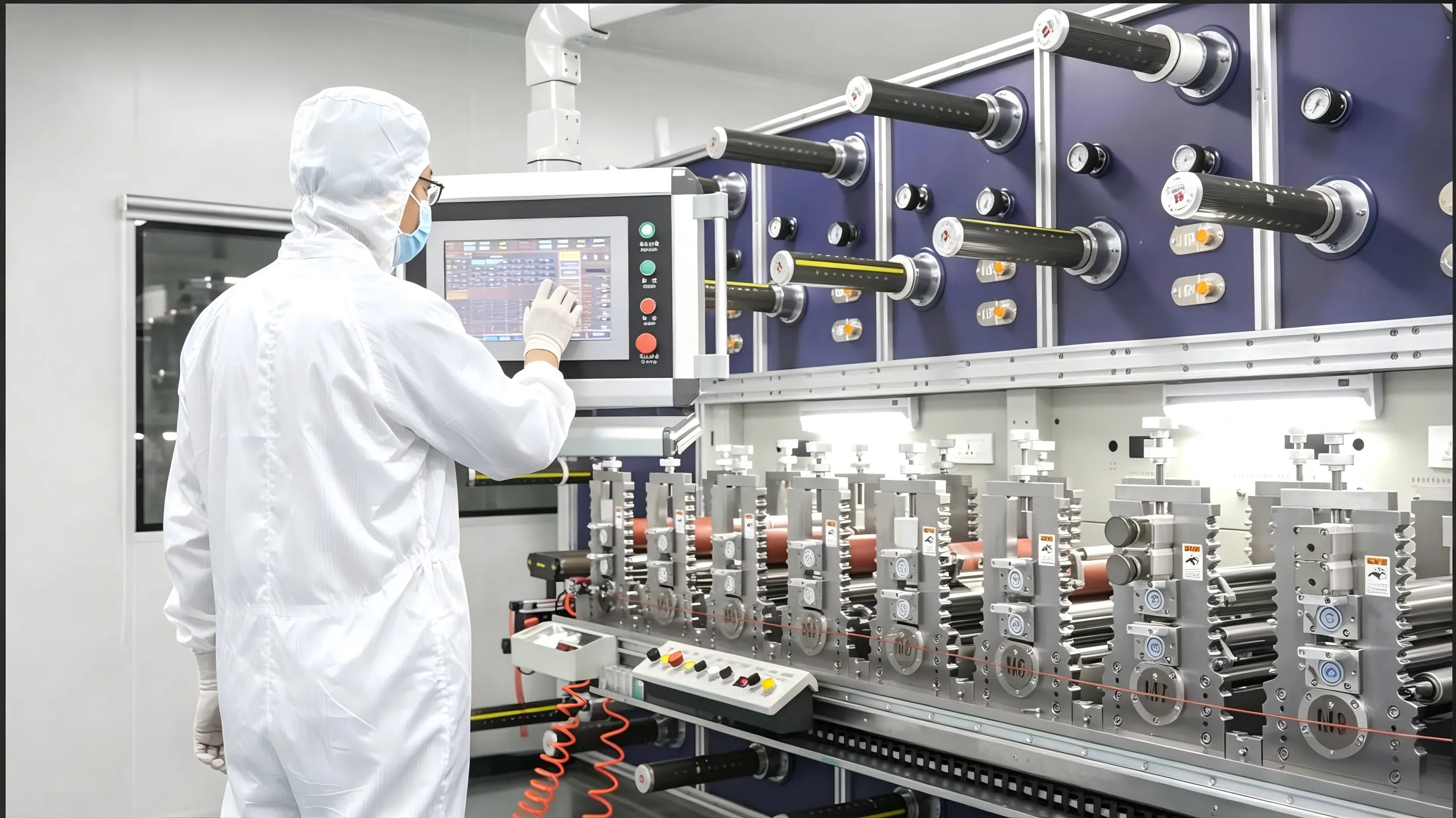
Converting Considerations: Lamination, Perforation and Cleanroom Control
Breathability is easily destroyed downstream. A full-surface lamination that squeezes adhesive into perforations, an over-tight web tension that closes pores in a nonwoven, or a printing pass that covers the vent area can each drop finished MVTR by a large margin. Rotary die cutting of perforated patterns requires tooling that cleanly removes the waste without tearing the web; flatbed cutting is more forgiving on delicate nonwovens but slower.
Cleanroom processing adds a second constraint: perforated and nonwoven webs generate particles when cut, so waste removal, web cleaning and gowning discipline matter. A converter that runs ISO Class 7 converting should be able to explain how perforation debris is controlled and how finished MVTR is monitored as a release characteristic rather than a one-off development measurement.
Test Methods and What to Ask a Converter For
Standard MVTR methods include cup-based gravimetric tests and instrumented infrared or modulated humidity techniques; the choice affects both the number and the reproducibility. For development, a consistent in-house method that ranks candidates relatively is often more useful than absolute values. For release, the method, conditions and sampling plan should be written down so that lot-to-lot data can be compared.
Beyond MVTR, ask for water uptake of the adhesive, peel after immersion, shear under a defined load at body temperature, and residue assessment after removal. A short wear panel — even ten volunteers over five days — will expose occlusion problems that bench data hides, and it is far cheaper than a field complaint cycle.
Common Failure Modes and Their Root Causes
Edge lift after showering usually indicates insufficient breathability combined with a low-shear-resistant adhesive at the perimeter. Residue on removal points to adhesive plasticized by moisture or to an over-soft gel. Itching without visible redness often comes from occlusion rather than from chemical irritation, and switching to a perforated or higher-MVTR backing resolves it more reliably than changing adhesive chemistry. Ring-shaped redness exactly matching the adhesive area suggests prolonged occlusion; redness concentrated at the edge suggests mechanical irritation from a stiff backing.
Mapping the symptom shape to the layer is the fastest diagnostic. For a broader symptom-to-cause matrix, see our article on acrylic versus silicone patch materials; for supplier-level questions about how these failure modes are controlled in production, start with Leetoya's manufacturing background.
Frequently Asked Questions
What MVTR should a 14-day CGM patch target?
There is no universal number, because patch area, wear site and patient activity all change the requirement. A practical approach is to compare candidate laminates against a construction with known field performance, then confirm with a short wear panel. Values quoted on backing datasheets are not directly usable as patch specifications.
Does perforating the backing weaken the patch?
It reduces the bonded area and introduces stress concentrations, so peel and shear per unit area drop. Designs usually compensate with a larger footprint, a pattern-coated adhesive, or a stronger perimeter bond.
Is a breathable film better than a nonwoven?
They solve different problems. Films give a smooth printable surface and tunable diffusion; nonwovens give higher transmission and a softer hand. The deciding factor is usually the mechanical load from the device housing and the desired cosmetic finish.
Can moisture problems be solved by changing adhesive alone?
Rarely. Occlusion is driven by the whole stack. Moving to a lower coat weight or a patterned adhesive helps, but if the backing and housing block transmission the interface stays wet.
How is breathability verified in production?
Most converters monitor incoming material MVTR by certificate and control perforation and lamination parameters in process. Finished-laminate MVTR is typically a development and periodic verification test rather than a 100% inspection.
Does breathability affect sterilization?
It affects gas and moisture exchange during sterilization and during shelf life. Porous constructions can absorb more moisture and require tighter packaging controls; the sterilization route should be chosen alongside the patch construction, not after it.
References
- U.S. FDA — 21 CFR Part 820 Quality System Regulation
- Dexcom — official CGM product and wear information
Discussing a long-wear patch construction? Leetoya can review your stack for moisture balance and converting feasibility. Request a drawing review.