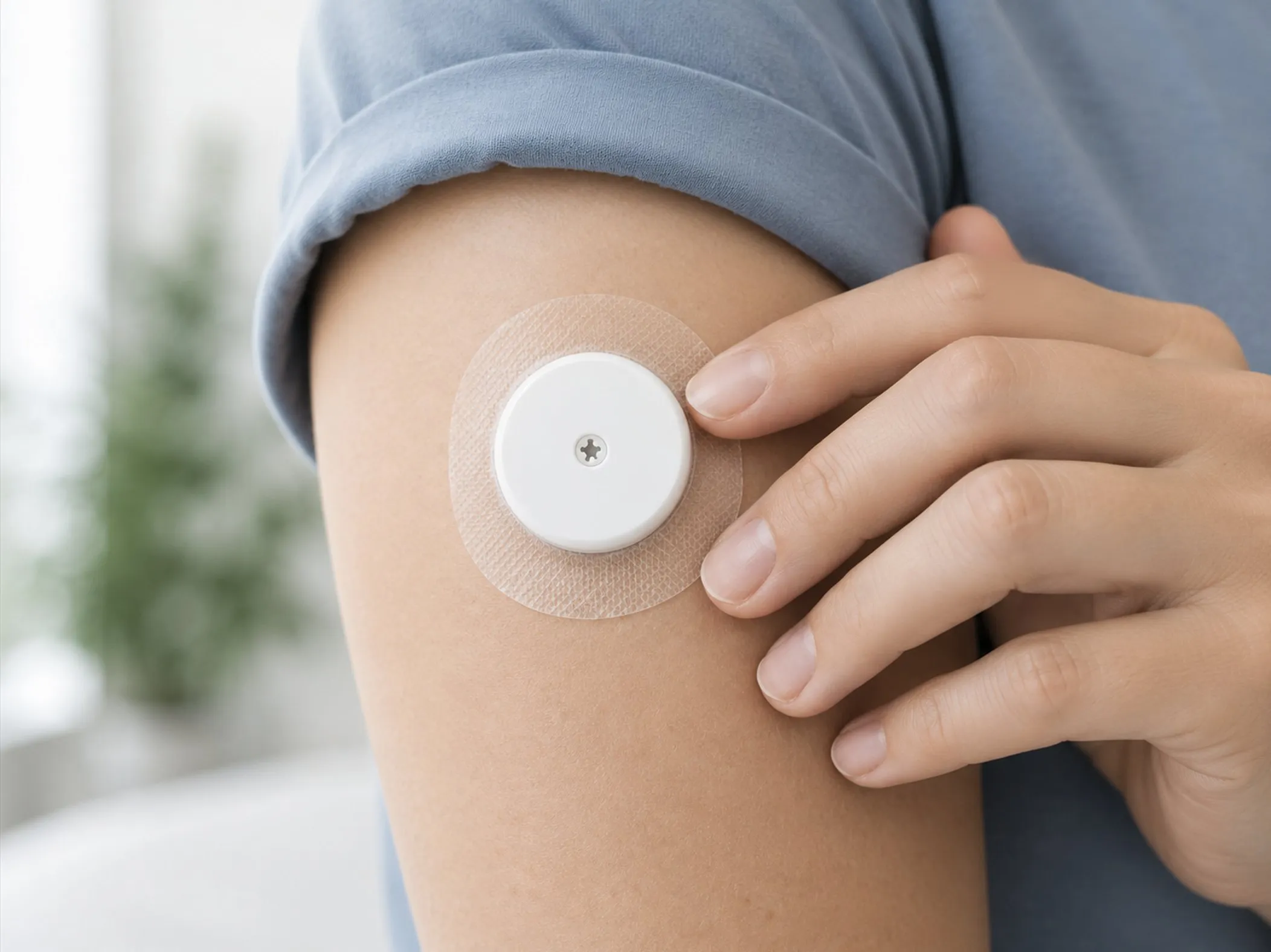
Two CGM patches can look identical in a photograph and behave completely differently on skin. The difference is almost always the adhesive chemistry, and the choice between acrylic and silicone is the single most consequential material decision in a CGM patch program. It affects wear time, moisture handling, removal trauma, manufacturing yield and cost per unit.
This article compares the two chemistries from a converting and device-engineering perspective rather than a catalogue perspective, then sets out how that choice changes lamination, die cutting and release liner selection.
What the Adhesive Has to Survive
A CGM sensor is worn continuously for one to two weeks, often during exercise, sleep and showering, on skin that varies from dry to oily. The patch must hold a sensor housing that presses into the skin, resist shear from clothing and movement, and still release without tearing the stratum corneum.
That combination is a set of conflicting requirements. Higher tack resists shear but increases removal trauma. Higher moisture vapour transmission reduces maceration but can weaken the adhesive interface. Softer gels spread and conform but flow under sustained load. Material selection is therefore a prioritisation exercise, and the priorities should come from your wear data rather than from a generic ranking.

Acrylic Adhesives: Profile and Strengths
Acrylic pressure-sensitive adhesives dominate wearable medical devices for several practical reasons. They deliver predictable initial tack and peel strength, they are available in a wide range of coat weights and chemistries, and they convert reliably at speed because the web has enough mechanical integrity to run through rotary presses without distorting.
Within acrylics, solvent-based systems generally offer the strongest cohesive structure and the best shear resistance, while emulsion acrylics trade some performance for lower volatile content and cost. For CGM patches that must anchor a sensor housing for fourteen days, the cohesive strength of an acrylic is usually welcome.
The trade-offs are well known to device teams. Acrylics are less breathable than open silicone gels, which raises maceration risk in sweaty conditions. Peel force is higher, so removal can be uncomfortable, particularly for patients with fragile or sensitive skin. And because acrylics wet out aggressively, they collect lint at a lifting edge.
Silicone Adhesives: Profile and Trade-offs
Silicone gel adhesives bond through soft, low-modulus contact rather than aggressive wet-out. The practical result is gentle removal, good conformability over irregular skin and a lower risk of mechanical trauma at the edge. For paediatric users, elderly patients and anyone applying a new sensor while the previous site is still healing, that matters.
Silicone gels also handle moisture differently. Formulations that are partially open allow moisture to pass, reducing the macerated ring that forms under occlusive patches. This is why silicone is often specified for long-wear sensors where skin health is the limiting factor rather than adhesion strength.
The trade-offs run in the other direction. Silicone peel strength is lower, so shear resistance under a heavier sensor housing can be marginal unless the patch area is increased or the housing is supported. Silicone coats are more expensive per square metre, they can be harder to laminate without entrapping air, and their low surface energy complicates liner selection. Some silicone systems also migrate into adjacent layers if the laminate is not designed around them.

Head-to-Head Comparison
| Property | Acrylic PSA | Silicone gel |
|---|---|---|
| Initial tack | High and predictable | Moderate, contact-driven |
| Shear resistance | Strong, suits heavier housings | Lower, depends on patch area |
| Moisture vapour transmission | Low to moderate | Moderate to high when formulated open |
| Removal trauma | Higher peel force | Gentle, low trauma |
| Skin health over long wear | Maceration risk under occlusion | Better moisture management |
| Converting behaviour | Runs well at speed, stable web | Softer, requires tension control |
| Liner compatibility | Broad | Narrower, low surface energy |
| Relative material cost | Lower | Higher |
Read the table as a trade, not a ranking. Neither column wins across all rows, and the correct answer depends on which row your complaint data implicates.
Hybrid and Specialty Constructions
Many CGM programs now avoid the binary choice. A common construction pairs a silicone skin-contact layer with an acrylic structural layer that carries the sensor housing, so the patient experiences gentle removal while the device still resists shear. Another approach uses a smaller acrylic anchor pad around the housing plus a larger silicone skirt for skin contact.
Hydrocolloid and hydrogel additions address a different problem: moisture absorbed at the edge. They are less relevant for a fourteen-day CGM sensor than for ostomy or wound products, but thin hydrocolloid rings do appear in high-sweat wear studies. Each added layer complicates lamination, so the design should justify it with wear evidence.
How Adhesive Choice Changes Converting
Adhesive chemistry changes the manufacturing plan more than buyers expect. Acrylic-coated rolls generally run at higher line speeds and tolerate rotary die cutting with tighter registration, because the web behaves like a stable film. Silicone gels are softer and more prone to distortion, so tension control, nip pressure and cut speed all narrow.
Liner selection follows the adhesive. Acrylics release from a broad range of silicone-coated liners; silicone gels need liners matched to their low surface energy or the patch will either block (fail to release) or pre-release in the roll. This is a converting problem that shows up as a patient complaint, which is why liner validation belongs with material selection rather than with packaging.
Finally, adhesive choice sets the practical tolerance for the whole stack. A soft silicone layer cut at high speed can smear at the edge, so the achievable edge quality is a function of chemistry as much as tooling.
A Selection Framework for Device Teams
Start from the failure you are trying to eliminate. If patches lift early under shear, the constraint is adhesion strength and patch geometry, and an acrylic or hybrid construction is the likely direction. If patches leave erythema or patients report painful removal, the constraint is skin interaction, and silicone or a hybrid with a silicone skin layer is the better bet. If the complaint is maceration under the patch after ten days, breathability and moisture management come first.
Then confirm the choice against manufacturing reality: ask the converter which liner pairs with the candidate adhesive, what coat weights are available, and what the achievable edge tolerance is on your geometry. A material that cannot be converted repeatably is not a material choice, it is a prototype.
For a deeper layer-by-layer view of patch construction, see our CGM patch material breakdown and the broader medical material library. Teams evaluating the general chemistry question can start with the silicone versus acrylic comparison guide.
Frequently Asked Questions
Is silicone better than acrylic for CGM patches?
Not universally. Silicone is better for skin tolerance, moisture handling and gentle removal; acrylic is better for shear resistance, cost and high-speed converting. Many programs use silicone at the skin interface and acrylic where the housing load is carried.
Why do CGM patches lift at the edge?
Edge lift usually comes from an exposed adhesive rim, insufficient patch area for the housing load, or moisture weakening the interface. It is a geometry and material issue together, and thicker adhesive does not fix it.
Can acrylic adhesive be made breathable?
Acrylics can be perforated or coated on breathable carriers to raise moisture vapour transmission, but the adhesive film itself remains relatively occlusive. If breathability is the primary constraint, an open silicone gel or a perforated construction is usually more effective.
How does adhesive choice affect patch cost?
Silicone raw material costs more per square metre and runs slower through converting, so unit cost is higher. That premium is often justified by reduced returns and complaints rather than by material performance alone.
Do CGM patches need a separate overpatch?
An overpatch is useful when the primary patch must stay thin for skin health but the housing needs extra anchorage, or when patients exercise heavily. It should be designed with the primary patch, not added as an afterthought, because two adhesives interact at the edge.
What test data should a converter provide for either chemistry?
Peel adhesion on a defined substrate, shear or static load resistance, moisture vapour transmission rate, and biocompatibility documentation for the finished stack. Ask how the values were measured, not only what they are.
Conclusion
Acrylic and silicone are not competing answers to the same question. Acrylic answers shear, cost and converting speed. Silicone answers skin tolerance, moisture and removal comfort. Most CGM programs end up with a hybrid because the device has both a mechanical problem and a dermatological one.
Leetoya laminates and die-cuts both chemistries into CGM patches and overpatches under ISO 13485 in ISO Class 7 conditions, and reviews adhesive, liner and carrier as a single stack. To discuss a specific wear requirement, see custom CGM adhesive patches.
Discuss your material requirements. Share the wear duration, sensor housing mass and current complaint mode, and we will propose a stack with matched liner and tolerance. Contact our engineering team.